7.31.2011

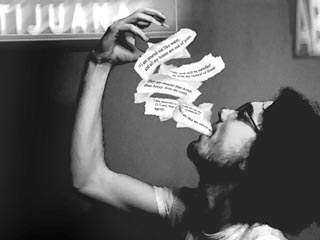
Libros made in Tijuana / Heriberto Yépez

Made in Tijuana Books


I will go over five recent books of literature from Tijuana.

Outside Tijuana few people know that for many years the work of Luis Humberto Crosthwaite was being read alongside that of Roberto Castillo Udiarte (1951), an emblematic poet of border literature. Nuestras vidas son otras. Antología personal 1985-2010 (Aullido Libros-Nortestación, 2010) gathers some of his poetry, which like his prose has the tone of a neighborhood guy, warm and informal. Castillo is a border classic.

Tijuana: crimen y olvido (Tusquets, 2010) by Luis Humberto Crosthwaite (1962), like other novels by him, is fragmentary and has a northern accent. Crosthwaite is usually paratactic and playful; in this book he decided to be more syntactic and dramatic. It would be simplistic to read this book only looking for a plot; one has to read it like a look-out post for narrative structures.

Tijuana writers have been influenced by English, multiculturalism, music and new technologies. Their rhetoric remixes. From Spanglish to the blog, Tijuana literature was born far from Mexico City; dreamed in casinos, currency exchanges, lines to reach the other side and nightspots, it took on its own form. Teejay style.

From this clique of synthetic writings we can still find the derivation of Señora Krupps (Static Books, 2010) by Javier Fernández (1971). More than short stories, machines of heterodox prose. The text of Tijuana distinguishes itself piece by piece through its framework. It conceives the page as menu, jukebox, Foreign Club and maquila factory.

Along with Crosthwaite’s, another book that circulates nationally is Confesión de un sicario. Testimonio de Drago, lugarteniente de un cártel mexicano (Grijalbo, 2011) by Juan Carlos Reyna (1980). Reyna grew up reading Crosthwaite, Castillo and Saavedra. His book is a journalistic application of the resources of Tijuana literature. The testimony of an assassin? Yes, but also a dose of Zeta magazine and Nortec. Reyna created the context for the drug dealer to be transcribed by border literature.

Crossfader 2.0. B-sides, hidden tracks & remixes (Nortestación, 2011) by Rafa Saavedra (1967) is the fifth book from this post-everything freelancer; the voice in off of a radiant desperation. Those who know how to read note that this post-literature is an open bar of verbosity. Noise and voices in clubs and parties. Page music. Pessoa plus pop.

Tijuana literature is made up of code-making, fusion and utopizzas.

Maybe it’s already over: the city that gave it a form is gone. Tijuana literature is a collection of postcards from its entropy.

TJ is a minor literature –Deleuze dixit– made by a minority within a bigger language. A defense of difference denied. Gregarious, over-codified, ironicized.

Except TJ doesn’t deterritorialize itself but rather, hyperterritorializes itself.

Tijuana didn’t write to continue Mexican Literature but instead to narrate a un-national city. To assemble literature, bi-tongue and music. Cool corrido: an other identity.


hyepez.blogspot.com


{ Heriberto Yépez, Suplemento Laberinto, Milenio (México D.F.), 30 July 2011 }

Derrota / Rafael Cadenas

Defeat

I who have never had a trade
who have felt weak facing every competitor
who lost the best titles for life
who barely arrive somewhere and already want to leave
          (believing that moving is a solution)
who have been denied in anticipation and ridiculed by
          the most able
who lean against the walls so I won’t completely collapse
who am a target of laughter even for myself
who thought my father was eternal
who have been humiliated by professors of literature
who one day asked how I could help and the answer was a
          loud laugh
who will never be able to start a home, nor be brilliant, nor
          triumph in life
who have been abandoned by many people because I barely
          speak
who am ashamed of acts I haven’t committed
who have needed little incentive to start running down
          the street
who have lost a center I never had
who have become the laughing stock of so many people for
          living in limbo
who never found anyone who would put up with me
who was omitted in favor of people more miserable than me
who will spend my whole life like this and who next year
          will be mocked many more times for my ridiculous
          ambition
who am tired of receiving advice from others more lethargic
          than me (“You’re so slow, get with it, wake up”)
who will never be able to travel to India
who have received favors without giving anything in return
who traverse the city from one end to another like a feather
who let myself be pulled along by others
who have no personality and don’t want to have one
who muffle my rebellion all day
who haven't joined the guerrillas
who haven’t done anything for my people
who don’t belong to the FALN and all these things and others
          whose enumeration would be interminable make me
          desperate
who cannot escape my prison
who have been dismissed everywhere for being useless
who actually haven’t been able to get married or go to Paris
          or have a serene day
who refuse to acknowledge facts
who always drool on my story
who am an imbecile and more than an imbecile from birth
who lost the thread of the discourse being executed within me
          and I haven’t been able to find it
who don’t cry when I feel the desire to do so
who arrive late to everything
who have been ruined by so many marches and
          countermarches
who desire perfect immobility and impeccable speed
who am not what I am nor what I am not
who despite everything maintain a satanic pride even if
          at certain hours I’ve been humble to the point of
          bringing myself to the level of stones
who have lived in the same circle for fifteen years
who thought I was predestined for something beyond
          the everyday and have achieved nothing
who will never wear a tie
who can’t find my body
who have perceived my falsehood in lightning flashes and
          haven’t been able to topple myself, sweep away
          everything and create my indolence, my flotation,
          my wandering a new freshness, and obstinately
          commit suicide within arm’s reach
I will get up off the ground even more ridiculous to keep
          mocking others and myself until the day of final
          judgment.


1963


{ Rafael Cadenas, Antología, Caracas: Monte Ávila Editores, 1996 }

7.29.2011

XVI / Manón Kübler

XVI

we were a secret squad that year, a retinue of men and women with the character of astronauts or teachers. a mysterious confederacy, a brotherhood of daily communions, the die cast, the apology or the peculiarity overwhelmed in ordinary and pathetic states of being. we wanted to grow with the glory of hardcover editions, magic biographies. we belonged to the frugal readings of borges, to reverón’s paintings, to russian cinema, to polish theater. we aspired to the names another might find perpetuated in eminent figures, on some city wall, in some mysterious and damp newspaper. we made no man’s land in the city of commons; we engendered repeated anecdotes in cafes that disappeared a hundred years ago, with the death of their tongues, perhaps. we deposited credits and tributes in prophets of “culture” with poor mouths because we were an excess of frozen ideas, of insipid gestures accompanied by citations. the baroque standing with artaud and freud walking hand in hand, it was said. we were undoubtedly inclined toward vanguards, a mockery of the true center, periphery of nothingness, for an episode of efforts and leaps, a spitting in the face of the anonymous who make their ideas collapse in the ministries and in managements. we nourished a lexicon of spent and unknown words. we were the fashion and have already passed.


{ Manón Kübler, Olympia, Caracas: Monte Ávila Editores, 1992 }

7.28.2011

IV / Manón Kübler

IV

i suppose today’s risky ascent through the inveterate walls of euphoria will soon lead me to an indescribable abyss. let’s say this is of no importance to the degree that you and i might be able to waste the creature of lack, as would be done in the best german poetry, where indolence ends up being a form of doubt and tragedy for the most immune of men. i lament being so distressingly moral and expecting that i must say so much to you in order to touch just one of your breasts.


{ Manón Kübler, Olympia, Caracas: Monte Ávila Editores, 1992 }

7.27.2011

II / Manón Kübler

II

i no longer am. i disappear in the confines of this room. alone, postponed, in the absurd belief of the child. foreseeing a threat that might keep me in mind. diminished. abrupt in the implements of doubt. as though tomorrow were to provide me a more intense health. but i’m an old woman in this room. i’m covered by the platonic response to suicides. i know nothing about myself even though i find myself again every day.


{ Manón Kübler, Olympia, Caracas: Monte Ávila Editores, 1992 }

7.26.2011

I / Manón Kübler

I

let us you and i take a long journey through the house of the living. of those exemplars who, well conserved ask about you and me. let us pause along the way on your bed so as to know ourselves alive, that we are the part that looks like the rough lines of night, the ones we don’t see, the ones we won’t ever try. give me the part of your body, that shore no one knows, not even the intimacies of your bathroom nor the discreet modesty of your mirror. i want to sleep with you at this hour so i know i have you beneath my hand, knees on your kidney, your back divided.


{ Manón Kübler, Olympia, Caracas: Monte Ávila Editores, 1992 }

7.25.2011

La cábala / José Antonio Ramos Sucre

The Kabbalah

The gentleman, with a famished face and savage beard, was crossing the old bridge suspended by means of chains.
     He dropped a carnation, passionate flower, in the insalubrious water of the creek.
     I was surprised to see him alone. A horseman with a faithful visor had been preceding him before, waving a banner on the vertex of his spear.
     They had been arguing at every moment, despite the solid friendship. The man had immersed himself in the science of the rabbis ever since his visit to secular Toledo. He would illuminate his lodgings with the seven-branched candelabrum, removed from the synagogue, and he had received it from his lover, a Jewish beauty seated on a tapestry from Smyrna.
     The servant resolves to save the gentleman from permanent seduction and persuades him to traverse a distant sea, where the names of the Italian admirals sound and the Cyclades, Horace’s refulgent islands, imitate the vocal chorus of the Oceanides.
     Cervantes recounted for me the incident of the gentleman restored to health. He reestablished himself when he discerned in a crowd of strollers the only dark-skinned maiden in Venice.


El cielo de esmalte (1929)


{ José Antonio Ramos Sucre, Obra completa, Caracas: Biblioteca Ayacucho, 1989 }

7.21.2011

Isabel / José Antonio Ramos Sucre

Isabel

I had received from the sky the present of an unfortunate beauty. Her benign eyes opened, full of fright, to the wonder of the world and a star of matutinal light, enchantment of hardened archangels, was extinguished at that same hour in the infinite. I was keeping a vigil at the margin of her crib and conceiving happy thoughts to brighten her future.
     I admitted her and kept her in my arms for the purpose of saving her childhood from the examples of the earth and from then on I directed her fervent voice to sing the agony of the Via Crucis and the resistance of the martyrs.
     I would retire on the vortex of a hill to watch over and defend her leisure in a recondite valley. The elegant lily of the parabola would alternate with the rose bush born and flowering in the same night on the tomb of Isolde.
     I followed her to an interview in the dawn hour, near a transparent river. She was enraptured when she focused on the discourse of an old man, a doctor or gentleman in the celestial kingdom, and got lost in the admiration of the sign of the cross, painted suddenly in the air. The hymn of some virgins was inviting her with instancy from a shining vessel.
     She spoke my name amid praises and promises before transfiguring and losing herself in space and in this manner she was able to incorporate me from the floor, where I had been toppled by the feeling of her absence.


El cielo de esmalte (1929)


{ José Antonio Ramos Sucre, Obra completa, Caracas: Biblioteca Ayacucho, 1989 }

7.20.2011

La vida mortecina / José Antonio Ramos Sucre

The Moribund Life

An involuntary glance had awakened passion. Affect returned from its lethargy in the manner of a fantastic being, of everlasting life and subject to a rhythm of activity and inertia.
     My house stood on the extreme end of a despoiled road. I lived far from diversions, engulfed in laborious thoughts. I was especially tending to the health of the soul and studying a lugubrious print, in which the angel of a prophetic threat dominates the solitude of abolished worlds.
     A memory was interrupting and wasting the unpleasant meditation. We had boldly saved ourselves from the calamity that took place in a carnival party. I took the extraordinary woman in my arms and pulled her to the shore of the old river, full of mud, where the ship of clamor burned.
     She was warning me now, by means of a confidante, of her project to visit me. I was preparing myself to receive her, in the secret of night, dressing according to the pageantry of the century. I had retired from the wardrobe the sword, the blue doublet and the mortarboard incarnate with a black feather.
     I awaited her sitting on the balcony and in the open air, until the moment the day broke. The humid air and the darkness increased my unease. I distinguished the woman’s profile, faint amid the sendals of dawn, on the line of the horizon.
     The confidante came soon afterward to ask me about the course and fate of her mistress. I could not find the means to answer and calm her impatience.
     The fruitless vigil had disheartened me and brought me back to remorse and tyrannical devotion. I discarded the gallant clothes and chose the mourning suit and the rosary to expiate the velleity of the interview.


El cielo de esmalte (1929)


{ José Antonio Ramos Sucre, Obra completa, Caracas: Biblioteca Ayacucho, 1989 }

7.18.2011

El nombre / José Antonio Ramos Sucre

The Name

One of King Solomon’s navigators was celebrating his adventures in a diaphanous sea and displaying the pearls and corals of the abyss. He didn’t move from his shoulders a bird with a human voice.
     Some lions threatened the ship from a burning coast. The seafarers were able to distinguish them amidst the glare and wounded them with fierce arrows.
     An old man with sharp features was governing the journey by night after humiliating himself in the presence of a red moon, reduced to a skiff. He belonged to a race of light customs, experienced at prospering from war, acquiring captives to resell.
     The sailors became frightened when they heard his vile discourse and presented him with his hands tied to the mouth of wild animals, where they roared most gravely.
     The old man was directing the ship to the gardens of oblivion lotus.
     The bird with human voice showed up soon afterward to guarantee the fortune of the navigation. A passenger tried to bring it down with his ivory bow. But he was dissuaded by the unanimous scream of the rest.
     The bird perched itself on the shoulder of the Hebrew navigator, author of the story. It was enunciating at every instant its owner’s name and retained in its wings a dressing room’s perfume. Happiness is the constant appellative of princesses in fantastical kingdoms.


El cielo de esmalte (1929)


{ José Antonio Ramos Sucre, Obra completa, Caracas: Biblioteca Ayacucho, 1989 }

7.05.2011

La suspirante / José Antonio Ramos Sucre

The Sighing Girl

The beautiful girl has returned from very far away. She locks herself in her inaccessible chamber again, satisfying herself with the svelte sofa and the exotic trinket. She imposes the memory of a stately era, surrounding herself with the successive scenes of a tapestry.
     The beautiful girl loses herself reading of extravagant events, occurring in imaginary kingdoms, and narrated with the semblance of parody. She returns to a burlesque passage, where a pastor alternates with the buffoon expelled from the court.
     The contemptuous lady engulfs herself in the peripeteia of an incomparable tale and suspends the entertainment when a battle begins between gentlemen with illustrious surnames.
     The reluctant lady, an aficionado of the chimeras of imagination, dreams of fleeing this world for another illusory one.
     No one would be able to investigate the direction of her escape.
     The beautiful girl flies over the roads blinded by snow and a solitary owl sounds the alarm in the night fascinated by the full moon.


Las formas del fuego (1929)


{ José Antonio Ramos Sucre, Obra completa, Caracas: Biblioteca Ayacucho, 1989 }

7.04.2011

El cristiano / José Antonio Ramos Sucre

The Christian

I would see him every day sitting at the door of his shack and with his head in his hands, sunken in an intense reflection. He would appear in that position close to nighttime, when the region’s equal sky would alter itself slightly with thin clouds of amber and violet.
     He had lost the most fertile years of life in the suffering of prison, as a result of an unjust accusation. His honesty had been preserved intact and had redeemed him at the start of old age. His superiors had allowed him to build his house in an open field. He had insinuated himself in the friendship of his companions and had softened the law of his destiny, clarifying for them the promises of the Gospel.
     I would visit him with frequency and follow him in his pilgrimages to the edge of the sea of whales and ice floes. He had substituted his real name with a false one and justified himself alleging his humility and his intention of resembling the wave merging in the sea.
     He taught me charity with animals. Before his death, he found me worthy of protecting his two closest friends. I moved to my house, on my shoulders, the furnishings from his and sent ahead of me a blue polar fox and a silken hare.


Las formas del fuego (1929)


{ José Antonio Ramos Sucre, Obra completa, Caracas: Biblioteca Ayacucho, 1989 }