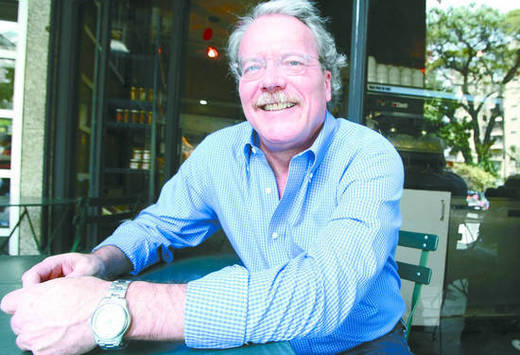
Alberto Barrera Tyszka: “Hugo Chávez made politics melodramatic”
[Photo: Camilo Rozo]
He was at his house in Caracas, in front of the TV, when he heard the news. Hugo Chávez, the president of Venezuela, that man who would speak from eternity, who had erased time with his speeches, announced that he had cancer. Alberto Barrera Tyszka (Caracas, 1960) was surprised, like the rest of the country. “It was something that wasn’t factored into any of the hypotheses,” recalls the author in a Bogotá café. He’s the winner of the latest Tusquets Prize in Spain for Patria o muerte, a novel born of various texts he was already writing and which were finally brought together by Chávez’s illness. The resulting book is a radiography of Venezuela today and it consecrates the writer, author of the biography Hugo Chavez: The Definitive Biography of Venezuela's Controversial President, perhaps the best biography of the Bolivarian leader, as the greatest exponent of his country’s literature, and in good measure of Latin America’s.
QUESTION. You return to Venezuela with this novel. What moved you to do that?
ANSWER. At first, I had no intention of approaching Chavismo through literature, probably as a reaction to the biography I wrote. But I was interested in the process in which Chávez’s illness appears, because I’m interested in the fragility of human beings, I try to connect with the reader through pain. It seemed to me like an ideal context for trying to inquire about Venezuelans and what we were living.
Q. What did you discover?
A. The novel tries to repeatedly address the topic of charisma. What happened for Venezuelans to become hooked, in favor of or against, on the same figure at the same time. But it isn’t a novel about Chávez, in the end he’s in the background, dying, it’s a novel about the Venezuelans who are living under that spell.
Q. Has that spell continued?
A. Chávez insisted a great deal on constructing himself as a myth, in sacralizing his own figure and, of course, the corporation that remained after that lives. But I thought that myth would last longer in the lives of Venezuelans. It’s not that present, or his heirs have squandered it very quickly. They’ve misspent the inheritance they were given in a quick and vulgar manner.
Q. It’s a novel, but it’s written as if it were non-fiction.
A. It engages in a very strong dialogue with the real, it includes many things I’ve heard. The writer is a type of spy who’s always stealing things he hears, looks at, watches. The stories kept emerging. One was from a novel I was writing before Chávez’s illness. There are people in literature who advance with plans, I’m not like that, I’m not too methodical, I advance blindly.
Q. On December 6th there will be elections for the National Assembly. How do you think change can happen in Venezuela?
A. I like to think that we’ve lived under the threat of a political violence that won’t materialize. I definitely think the opposition can win. But, how will the Government administer that triumph, that’s the problem. They want to present democratic alternation as a crime. Chavismo doesn’t realize that it failed in its attempt to impose its model. The only possible exit for Venezuelans is to accept our complexity, to overcome the mediocrity that polarization represents. There’s no possibility of building a country if we can’t count on each other. Those who think history is an interruptor and that we’ll return to 1998, before Chávez came to power, are mistaken.
Q. What have you felt after writing something so real, but so harsh about your country?
A. I was very scared it would sound like an op-ed novel, that people would think it was written in order to denounce. No, I don’t want to denounce a regime or anything like that, but rather to tell the story of the plurality that exists in the country.
Q. Plurality and polarization.
A. It’s part of Venezuela’s reality, children who don’t talk to their parents, estranged siblings. Chávez made politics melodramatic. A moment arrived when it seemed Venezuelans had been born to attack or support a government.
Q. What type of novel is Venezuela?
A. I think there’ll soon be a lot of books that have to do with the country’s situation. The time is right for writers to begin writing or thinking about what we’re living. People have started to find refuge and seek something in books that they haven’t found in the media, which is reliability. There has been a resurgence of history books, of journalism. The media polarization makes everyone unreliable. Although there’s also the phenomenon of investigative journalists who’ve moved to websites, very serious people with acknowledged prestige have been doing investigative journalism from those pages: Armando.info, Runrunes, Contrapunto...
Q. What do you enjoy the most when it comes to writing?
A. Television is work that feeds me. What I enjoy the most is literature. Even more than the column I write for El Nacional. When I started to write columns 20 years ago it was something more personal. Now if I write about the clouds I get stoned by people. There’s a type of dictatorship of political urgency and society is in submission to it. As if no other vital spaces existed.
Q. What do telenovelas provide you when it comes time to write literature?
A. They’re very different formats. In literature the imagination and ambiguity are fundamental. Television can’t handle that complexity, it’s a kingdom closer to the stereotype. But it’s given me more efficiency for dialogue and a better idea of narrative speed.
Q. A prestigious scriptwriter, you won the Herralde Prize, now the Tusquets. You’re touched by success.
A. No, it’s not true. I wouldn’t even mention it. I’m very disciplined. Prizes give you a sensational push, but it doesn’t mean you’ll write better. You can’t believe that.
{ Javier Lafuente, Babelia, El País, 26 November 2015 }
Showing posts with label Alberto Barrera Tyszka. Show all posts
12.01.2015
10.21.2015
Two Venezuelan Writers Among the Great Hopes of the Frankfurt Book Fair
[Venezuelan novelist Alberto Barrera Tyszka. Photo: El Universal]
For five days, the main publishing houses and agencies of the world gathered at the Frankfurt Book Fair, perhaps the biggest event in the world dedicated to the commercialization of rights for projects in the literary world.
Around 140,000 professionals and 7 thousand exponents from approximately one hundred countries gathered at this event where two Venezuelan writers were catalogued as great literary hopes after reaching agreements with foreign publishing houses for the translation and publication of their novels.
The Caracas-born writers Alberto Barrera Tyszka, who was recently awarded the 2015 Tusquets Prize in Spain, and Rodrigo Blanco Calderón were highly valued for their novels Patria o muerte and The Night, respectively.
International media have mentioned that the material by Barrera Tyszka was particularly successful and will be read in France, Holland, Portugal, Sweden, Germany and the United States thanks to the agreements. The novel makes reference to the Venezuelan crisis and narrates episodes tied to the final days of the ex-president Hugo Chávez.
Blanco Calderón mentions that his work was negotiated with the French publishing house Gallimard, and he expects it will be released at the beginning of 2016, close to its publication date with Alfaguara in Spain. Moreover, he doesn’t rule out the possibility that publishing houses from other countries might become interested in the translation of his book. “This week I’ll speak with my agent and will know further details, but I’m aware that other negotiations were taking place,” he declared.
According to Blanco Calderón, “book fairs of this magnitude allow a writer to reach certain areas of reading, commentary and dissemination that an author from any country wouldn’t be able to attain on his own. That’s the value of this possibility, because it allows us to open up slightly the barrier between Venezuelan literature and the world.”
Among other Latin American revelations, highlights also included the recently-deceased Canek Guevara, grandson of Che Guevara, who will publish 33 revoluciones with Alfaguara in Spain, in which he critiques Fidel Castro’s regime; and the Colombian Héctor Abad Faciolince, with his book La Oculta, to be published by Gallimard.
{ El Universal, 20 October 2015 }
For five days, the main publishing houses and agencies of the world gathered at the Frankfurt Book Fair, perhaps the biggest event in the world dedicated to the commercialization of rights for projects in the literary world.
Around 140,000 professionals and 7 thousand exponents from approximately one hundred countries gathered at this event where two Venezuelan writers were catalogued as great literary hopes after reaching agreements with foreign publishing houses for the translation and publication of their novels.
The Caracas-born writers Alberto Barrera Tyszka, who was recently awarded the 2015 Tusquets Prize in Spain, and Rodrigo Blanco Calderón were highly valued for their novels Patria o muerte and The Night, respectively.
International media have mentioned that the material by Barrera Tyszka was particularly successful and will be read in France, Holland, Portugal, Sweden, Germany and the United States thanks to the agreements. The novel makes reference to the Venezuelan crisis and narrates episodes tied to the final days of the ex-president Hugo Chávez.
Blanco Calderón mentions that his work was negotiated with the French publishing house Gallimard, and he expects it will be released at the beginning of 2016, close to its publication date with Alfaguara in Spain. Moreover, he doesn’t rule out the possibility that publishing houses from other countries might become interested in the translation of his book. “This week I’ll speak with my agent and will know further details, but I’m aware that other negotiations were taking place,” he declared.
According to Blanco Calderón, “book fairs of this magnitude allow a writer to reach certain areas of reading, commentary and dissemination that an author from any country wouldn’t be able to attain on his own. That’s the value of this possibility, because it allows us to open up slightly the barrier between Venezuelan literature and the world.”
Among other Latin American revelations, highlights also included the recently-deceased Canek Guevara, grandson of Che Guevara, who will publish 33 revoluciones with Alfaguara in Spain, in which he critiques Fidel Castro’s regime; and the Colombian Héctor Abad Faciolince, with his book La Oculta, to be published by Gallimard.
{ El Universal, 20 October 2015 }
6.26.2012
The Sickness by Alberto Barrera Tyszka
(Alberto Barrera Tyszka in 2011 by Vasco Szinetar)
Alberto Barrera Tyszka, tr. Margaret Jull Costa, The Sickness (Portland & New York: Tin House Books, 2012)
Why has Venezuelan literature remained so completely untranslated and unknown in the United States and England? When compared to other Latin American countries, such as Mexico, Colombia, Peru, Argentina, or Chile, the number of Venezuelan writers translated into English has always been minimal. This hasn’t been for a lack of innovative, important writers. But Venezuela’s invisibility in the global literary landscape is an issue we don’t have time to address here. Regardless of that dilemma, Venezuelan literature has been experiencing a boom for the past decade, with an avalanche of publications, awards, workshops, presentations and a growing readership in Venezuela, Latin America and Spain. The Venezuelan boom is particularly evident in the field of fiction, where several generations of writers are currently producing work that is worthy of attention well beyond the country’s (or Latin America’s) borders. This spring gave us the publication in English of a short novel that’s emblematic of the Venezuelan literary boom at the beginning of the 21st century.
Alberto Barrera Tyszka (Caracas, 1960) was awarded the Herralde Prize by Editorial Anagrama in Barcelona, Spain for his novel La enfermedad in 2006. The award, which has been bestowed on the likes of Roberto Bolaño, Enrique Vila-Matas and Juan Villoro, helped catapult Barrera Tyszka’s name throughout the Spanish-speaking world. In Venezuela, Barrera Tyszka is a widely-read journalist, novelist and poet. His Sunday column in the newspaper El Nacional is one of the most widely-read in the country. There he tends to focus on Venezuela’s continuing political crisis, offering a partisan yet open-minded analysis of the country’s complicated situation from an opposition point of view. Barrera Tyszka makes his living as a scriptwriter for Spanish-language soap operas, or telenovelas. He’s also a Professor of Literature in the Escuela de Letras at the Universidad Central de Venezuela. These branches of his life as a public intellectual aren’t necessarily evident in this quick-paced, intimate novel. And yet, the efficient prose imbued with subtle poetic charge that Barrera Tyszka employs in this novel makes it a rare event. Writing about a terminal situation where the death of one of the main characters is announced within the first paragraph, he manages to keep the reader engaged in the unfolding layers of several lives that intersect with a dying father and his son during a period of several weeks.
In 2010, La enfermedad was published in a translation by Margaret Jull Acosta as The Sickness in England, where it received positive reviews and was short-listed for the Independent Foreign Fiction Prize. Now it’s been published here in the United States by Tin House Books. The novel concerns a doctor in Caracas named Andrés Miranda who finds out his father has terminal cancer. Dr. Miranda struggles with the news and how to tell his father, Javier Miranda. This central storyline is accompanied by several others that Barrera Tyszka masterfully weaves alongside the protagonist’s awareness of his father’s impending death. We follow the drama of a patient of Dr. Miranda who is convinced he has a grave illness, even after several doctors find nothing wrong with him. The patient begins to stalk Dr. Miranda and this leads him into an e-mail correspondence with the doctor’s secretary. Another thread develops after Javier Miranda finds out he is dying and tries to establish some sense of dignity as he faces a terrifying reality. We get to know his maid, a young woman who is struggling to keep her teenage son safe from the dangers of the hillside slum where they live, while helping the dying man confront his death. She ends up accompanying Javier to a self-help group called “Learning to Die” and they develop a friendship that remains distant yet irrevocably dependent on the other’s situation.
While the the central plot and its various satellites are wonderfully balanced, the novel builds up a tension the reader begins to feel as the inevitable death draws near. Barrera Tyszka portrays his characters, whether they are central to the novel or make minor appearances of less than a page, as living beings whose imperfections and complexities can sometimes make the book feel like a documentary, as though we’re peeking over someone’s shoulder at moments that might be too private or vulnerable. Barrera Tyszka’s varying roles as a telenovela scriptwriter, poet and newspaper columnist seem to contribute to the way language in this novel is so successfully employed, simultaneously accessible yet evocatively poetic. One example of this dual quality in his prose is the motif of language itself, and how it’s distorted by illness. When Andrés Miranda first sees the results of the tests that reveal his father’s cancer, we are presented with the idea of language, words themselves, being destroyed by the body and its illness:
“Andrés has a hedgehog on his tongue. His throat fills with pineapple rind.” (22)
Throughout the novel, Andrés alludes to a variety of writers whose work addresses the philosophical implications of medicine and the awareness of death. These interludes include figures such as Charles Baudelaire, Michel Foucault, William Carlos Willams and Susan Sontag. In this sense, we’re never able to forget that this is a poet’s novel, one that’s just as concerned with ideas as it is with action, plot and character development. The axis of the novel is a trip Andrés and Javier take to the island of Margarita, where he hopes to break the news to his father. They spend a week there and Andrés is unable to address the issue, until the words finally come out as if on their own, awkwardly, and without grace. His father is obviously stunned, and in describing his reaction Barrera Tyszka again turns to the disintegration of language:
“Andrés could see that his eyes were wet with tears and that beneath those tears lay something resembling both melancholy and rancor, some emotion for which the dictionary did not yet have a word.” (118)
Language is one of several themes that Barrera Tyszka obsessively returns to throughout the novel (along with memory, social norms, family, books, and health). These obsessive repetitions are shaped into a coherent story told in pieces, where the end result is known from the fist page. What keeps our attention is the way the story is told, a multitude of vivid fragments clustered around Javier Miranda’s dying body. There is no relief in this novel for the reader, much less for the doctor who’s accustomed to being a detached observer:
“For the first time, it occurs to him that the illness might take away from himself and his father something he had never thought it would: conversation, the ability to talk to each other. The illness is destroying their words as well.” (154)
What Alberto Barrera Tyszka does provide us is a map of tenderness, elusive moments of pain endured in the company of others, whether family or friends or acquaintances. It’s telling that the ever-present topic of Venezuela’s political crisis is turned into a minor aside in the book. Andrés and Javier do talk about it, but soon grow bored of the topic. Barrera Tyszka is instead concerned with creating a novel that is in a sense timeless, although the setting could only be Caracas, Venezuela in the early 2000s. The Sickness ends with yet another poetic image based on the power of language to interpret and heal. We’re not spared from Javier Miranda’s inevitable decline, but we are reminded of why the novel remains such a dynamic form, one that can include any type of discourse in the service of its goals, among them to entertain and enlighten.
4.09.2007
Latinoamérica en diferido / Alberto Barrera Tyszka
Latin America in Deferment
They’re waiting near one of the boarding gates at the Charles de Gaulle International Airport. They’ve come from different countries, they’re a large group. Most of them are carrying backpacks. Even though it’s winter, some of the kids are only wearing shorts and t-shirts. They don’t care about the cold. They’re going to the tropics. They’re going to travel, for the first time, to a revolution.
In Latin America, revolutions are also a non-traditional product for export. It is a matter of a charm that is as typical of us as pretentiousness or corn, mariachis or chocolate. We also have sentimental caudillos, necessary rebels, a class of heroes that can no longer be found anywhere else in the world. People that seem to have been taken out of a forgotten cinema epic. We are almost the planet’s retro TV channel. All those who still feel a nostalgia for history can come here.
Maybe that’s why Latin American revolutions tend to be so much more successful abroad than in their own countries. Some foreigners are fascinated by how a man of action in our region is always a man of arms, that democracies are a minor whim in comparison to the urgencies of reality, that a country can administer itself by means of authoritarian abuse and bullets. Like a shamanic ritual, like the rustic sun or the red Bolivian poncho, Latin American revolutions seem to naturally fit the fantasy certain people have about us. For many foreigners we continue to be incomprehensible cultures. What is disproportionate, ridiculous, absurd…is suddenly perceived as an act of honesty, as though it were the genuine emblem of our supposed identity.
Juan Villoro affirms: “One of the most serious and subtle results of Eurocentrism is that the search for the authentic privileges the picturesque.” In certain fields, this can even be charming and congenial, but in politics it undoubtedly ends up being tragic. What would be unacceptable in any European republic, is nonetheless legitimate if it happens in our countries.
The most emblematic example is Fidel Castro. A man who governs a country since almost 50 years ago, implementing a regime of a militaristic nature, where the right to information does not exist and where a large percentage of dissidents are in jail, this man is still thought of – by certain sectors of European culture – as a libertarian leader, as a hero of oppressed Latin America. Europe has taken magical realism much too seriously. It thinks the exotic is our birth certificate, our guarantee of authenticity.
The predetermined design, the preset idea, conceived for Latin America is so strong, so overwhelming, that it probably clouds any other diverging sign that might not come from the same reality. We could almost speak of an ideological tourism that comes to Latin America not to get to know the region but to verify that the imagined Latin America actually exists. The kids that wait to board a plane at the airport in Paris only travel to confirm what they already know, even though they haven’t seen it. They don’t come here to be surprised by an unknown reality but to sensibly confirm that the reality they already know is here, within their reach. More than countries we are theme parks, where the spectacle of inequality rotates, according to what the case might be, its indigenous people, its soldiers, its shirtless, its corrupt politicians, its sugar cane alcohol, its dances and its fried food, its songoroconsongo de mamey.
One of the most visible aspects of certain Europeans, including many journalists, is their lack of curiosity, of doubts: the naiveté with which they accept the versions that correspond with the territory they've dreamed. To what Edward Said calls “the rhetoric of guilt,” we also have to add a certain anxiety toward history, the result of which unfortunately seems to be the annulment of complexity. From that perspective, in the name of fighting inequality and poverty, in the name of confronting the culture of the United States, anything is accepted, allowed. In its depths, it is a vision constructed at a distance, they always see us in deferment, as though our history had actually already happened, as though they already knew the destiny that awaits us, that is good for us.
The kids will return to Charles de Gaulle this same winter. One of them might bring a bongo drum as a souvenir. Another one, a t-shirt stamped with a portrait of Che next to Hugo Chávez. Many photos. They’ll distribute the good news: beyond the ocean everything is marvelous and disorganized; beyond the ocean there exists the confused paradise that continent deserves. That’s how it is. Latin American revolutions always tend to be beneficial. Especially if one visits them, if one does not live them.
{ Alberto Barrera Tyszka, El Nacional, 8 April 2007 }
They’re waiting near one of the boarding gates at the Charles de Gaulle International Airport. They’ve come from different countries, they’re a large group. Most of them are carrying backpacks. Even though it’s winter, some of the kids are only wearing shorts and t-shirts. They don’t care about the cold. They’re going to the tropics. They’re going to travel, for the first time, to a revolution.
In Latin America, revolutions are also a non-traditional product for export. It is a matter of a charm that is as typical of us as pretentiousness or corn, mariachis or chocolate. We also have sentimental caudillos, necessary rebels, a class of heroes that can no longer be found anywhere else in the world. People that seem to have been taken out of a forgotten cinema epic. We are almost the planet’s retro TV channel. All those who still feel a nostalgia for history can come here.
Maybe that’s why Latin American revolutions tend to be so much more successful abroad than in their own countries. Some foreigners are fascinated by how a man of action in our region is always a man of arms, that democracies are a minor whim in comparison to the urgencies of reality, that a country can administer itself by means of authoritarian abuse and bullets. Like a shamanic ritual, like the rustic sun or the red Bolivian poncho, Latin American revolutions seem to naturally fit the fantasy certain people have about us. For many foreigners we continue to be incomprehensible cultures. What is disproportionate, ridiculous, absurd…is suddenly perceived as an act of honesty, as though it were the genuine emblem of our supposed identity.
Juan Villoro affirms: “One of the most serious and subtle results of Eurocentrism is that the search for the authentic privileges the picturesque.” In certain fields, this can even be charming and congenial, but in politics it undoubtedly ends up being tragic. What would be unacceptable in any European republic, is nonetheless legitimate if it happens in our countries.
The most emblematic example is Fidel Castro. A man who governs a country since almost 50 years ago, implementing a regime of a militaristic nature, where the right to information does not exist and where a large percentage of dissidents are in jail, this man is still thought of – by certain sectors of European culture – as a libertarian leader, as a hero of oppressed Latin America. Europe has taken magical realism much too seriously. It thinks the exotic is our birth certificate, our guarantee of authenticity.
The predetermined design, the preset idea, conceived for Latin America is so strong, so overwhelming, that it probably clouds any other diverging sign that might not come from the same reality. We could almost speak of an ideological tourism that comes to Latin America not to get to know the region but to verify that the imagined Latin America actually exists. The kids that wait to board a plane at the airport in Paris only travel to confirm what they already know, even though they haven’t seen it. They don’t come here to be surprised by an unknown reality but to sensibly confirm that the reality they already know is here, within their reach. More than countries we are theme parks, where the spectacle of inequality rotates, according to what the case might be, its indigenous people, its soldiers, its shirtless, its corrupt politicians, its sugar cane alcohol, its dances and its fried food, its songoroconsongo de mamey.
One of the most visible aspects of certain Europeans, including many journalists, is their lack of curiosity, of doubts: the naiveté with which they accept the versions that correspond with the territory they've dreamed. To what Edward Said calls “the rhetoric of guilt,” we also have to add a certain anxiety toward history, the result of which unfortunately seems to be the annulment of complexity. From that perspective, in the name of fighting inequality and poverty, in the name of confronting the culture of the United States, anything is accepted, allowed. In its depths, it is a vision constructed at a distance, they always see us in deferment, as though our history had actually already happened, as though they already knew the destiny that awaits us, that is good for us.
The kids will return to Charles de Gaulle this same winter. One of them might bring a bongo drum as a souvenir. Another one, a t-shirt stamped with a portrait of Che next to Hugo Chávez. Many photos. They’ll distribute the good news: beyond the ocean everything is marvelous and disorganized; beyond the ocean there exists the confused paradise that continent deserves. That’s how it is. Latin American revolutions always tend to be beneficial. Especially if one visits them, if one does not live them.
{ Alberto Barrera Tyszka, El Nacional, 8 April 2007 }
1.21.2007
La enfermedad
I've come to know the work of poet and novelist Alberto Barrera Tyszka (Caracas, 1960) mainly through his Sunday column in El Nacional. He shares a page with Simón Alberto Consalvi and Tulio Hernández, a page that's become an essential part of my Sundays for several years now. In distinct ways, they each offer valuable insights on the permanent political and social crisis that is today's Venezuela. Barrera Tyszka will eventually become known to a wider audience when the biography of Hugo Chávez he co-wrote (with his wife Cristina Marcano) is published in English translation later this year by Random House. At the moment, his second novel La enfermedad (Anagrama, 2006) has just won the prestigious Premio Herralde in Barcelona, Spain, marking a watershed moment for contemporary Venezuelan literature.
Barrera Tyszka began to publish in the early 1980s, when he was associated with a group of young poets who called themselves Guaire (after the river that runs through Caracas). The poets of Guaire first met as students at the Universidad Católica Andrés Bello and, along with the slightly older group of writers named Tráfico, they were influential proponents of an urban, conversational poetry whose aim was to reflect the postmodern, violent and booming city of Caracas. Several of Barrera Tyszka's poems were recently included in the anthology of Venezuelan poetry edited by Joaquín Marta Sosa, Navegación de tres siglos (Caracas: Fundación Para la Cultura Urbana, 2003). I've translated one of these poems below:
Poetics
It should be clean and brilliant,
like a razor blade
sunk in a glass of wine.
Like a sprig of basil
on the ice.
It should be mortal,
always.
Like desire.
*
Poética
Ha de ser limpia y brillante,
como una hoja de afeitar
hundida en una copa de vino.
Como un tallo de albahaca
sobre el hielo.
Ha de ser mortal,
siempre.
Como el deseo.
La enfermedad (The Illness) is 168 pages long but reads like a much shorter novella. Its devastating story is deeply rooted in the atmosphere of Caracas today and yet the plot could ostensibly take place anywhere. The book's central concern is the emotional and philosophical implications of illness as an antechamber to death. The story concerns a doctor who finds out that his father has terminal cancer and only a few weeks to live. While he's trying to figure out how to break the news to his 69 year-old father, one of his former patients is convinced that he himself is dying, even though all medical tests show him to be perfectly healthy. Barrera Tyszka weaves in several other strands into the novel, and some of the book's most compelling scenes involve characters that appear only for a few pages.
Barrera Tyszka has made his living as a journalist and as a writer of telenovelas. This is important to his prose style in this novel, which fluctuates between matter-of-fact realism and an intriguing series of overlapping plot lines. One of the reasons the book reads like a novella is that we know from the very first page that death will be the vortex of the narrative. In one way or another, all the characters in the book are enveloped in the uncertainty and dread that physical and mental illness create. Barrera Tyszka masterfully delineates the very subtle class differences that exist in a massive and chaotic city such as Caracas, and he definitely makes allusions to the political turmoil Venezuela has endured for nearly a decade now. And yet, this novel's devastating power comes primarily from the smallest moments of human interaction.
Those interactions are often not fulfilling for the characters. In fact, the book frequently lingers on moments of miscommunication and misunderstanding, even between family and lovers. Throughout the story, Barrera Tyszka's protagonist recalls books he's read that ruminate on illness, including texts by Robert Burton, Susan Sontag, William Carlos Williams, Joseph Roth and Anton Chekov. But these texts provide little comfort against the ravages of a cancer that is quickly killing his father. One of the texts the doctor recalls is from the journals of the Peruvian novelist Julio Ramón Ribeyro: "Physical pain is the great regulator of our passions and ambitions. Its presence immediately neutralizes any other desire besides the disappearance of pain."
Part of this novel's beauty comes from its eloquent portrayal of how even the most prepared among us can be overwhelmed or ambushed by disaster. At an allegorical level, the novel is a study of how illness affects not only individuals but society as a whole. Written as it was during one of the most tumultuous moments in Venezuelan history, one can read this book as an investigation of a nation's psyche as it endures a sickness that leaves no one untouched. But again, the book never leaves the intimate register of humans facing death and loss in daily, mundane moments. The book makes no attempt to understand illness and death but rather it observes how each of us might react to their presence. Barrera Tyszka's novel offers no solace besides the compelling and nearly-physical beauty of his "clean and brilliant" prose.
Barrera Tyszka began to publish in the early 1980s, when he was associated with a group of young poets who called themselves Guaire (after the river that runs through Caracas). The poets of Guaire first met as students at the Universidad Católica Andrés Bello and, along with the slightly older group of writers named Tráfico, they were influential proponents of an urban, conversational poetry whose aim was to reflect the postmodern, violent and booming city of Caracas. Several of Barrera Tyszka's poems were recently included in the anthology of Venezuelan poetry edited by Joaquín Marta Sosa, Navegación de tres siglos (Caracas: Fundación Para la Cultura Urbana, 2003). I've translated one of these poems below:
Poetics
It should be clean and brilliant,
like a razor blade
sunk in a glass of wine.
Like a sprig of basil
on the ice.
It should be mortal,
always.
Like desire.
*
Poética
Ha de ser limpia y brillante,
como una hoja de afeitar
hundida en una copa de vino.
Como un tallo de albahaca
sobre el hielo.
Ha de ser mortal,
siempre.
Como el deseo.
La enfermedad (The Illness) is 168 pages long but reads like a much shorter novella. Its devastating story is deeply rooted in the atmosphere of Caracas today and yet the plot could ostensibly take place anywhere. The book's central concern is the emotional and philosophical implications of illness as an antechamber to death. The story concerns a doctor who finds out that his father has terminal cancer and only a few weeks to live. While he's trying to figure out how to break the news to his 69 year-old father, one of his former patients is convinced that he himself is dying, even though all medical tests show him to be perfectly healthy. Barrera Tyszka weaves in several other strands into the novel, and some of the book's most compelling scenes involve characters that appear only for a few pages.
Barrera Tyszka has made his living as a journalist and as a writer of telenovelas. This is important to his prose style in this novel, which fluctuates between matter-of-fact realism and an intriguing series of overlapping plot lines. One of the reasons the book reads like a novella is that we know from the very first page that death will be the vortex of the narrative. In one way or another, all the characters in the book are enveloped in the uncertainty and dread that physical and mental illness create. Barrera Tyszka masterfully delineates the very subtle class differences that exist in a massive and chaotic city such as Caracas, and he definitely makes allusions to the political turmoil Venezuela has endured for nearly a decade now. And yet, this novel's devastating power comes primarily from the smallest moments of human interaction.
Those interactions are often not fulfilling for the characters. In fact, the book frequently lingers on moments of miscommunication and misunderstanding, even between family and lovers. Throughout the story, Barrera Tyszka's protagonist recalls books he's read that ruminate on illness, including texts by Robert Burton, Susan Sontag, William Carlos Williams, Joseph Roth and Anton Chekov. But these texts provide little comfort against the ravages of a cancer that is quickly killing his father. One of the texts the doctor recalls is from the journals of the Peruvian novelist Julio Ramón Ribeyro: "Physical pain is the great regulator of our passions and ambitions. Its presence immediately neutralizes any other desire besides the disappearance of pain."
Part of this novel's beauty comes from its eloquent portrayal of how even the most prepared among us can be overwhelmed or ambushed by disaster. At an allegorical level, the novel is a study of how illness affects not only individuals but society as a whole. Written as it was during one of the most tumultuous moments in Venezuelan history, one can read this book as an investigation of a nation's psyche as it endures a sickness that leaves no one untouched. But again, the book never leaves the intimate register of humans facing death and loss in daily, mundane moments. The book makes no attempt to understand illness and death but rather it observes how each of us might react to their presence. Barrera Tyszka's novel offers no solace besides the compelling and nearly-physical beauty of his "clean and brilliant" prose.
1.07.2007
El año de la prudencia / Alberto Barrera Tyszka
The Year of Prudence
At two in the morning, like a flabby and confused ghost, as the smoke from the fireworks still floated over the sky of Caracas, I suddenly had a brief philosophical spasm. For a few seconds I felt like Baruch Spinoza, I was overcome by that classic ontological ebb that occurs after the announcement “Five minutes ‘til midnight” and, staring straight into the night, I asked myself at that moment what the hell we can expect from this year 2007.
Anyone knows that the future is an uncertainty. But to assume, on top of that, that the future is a Bolivarian uncertainty is too much, is already an excess: insecurity canned in the void, chemically pure uncertainty. Everything can happen: the gringos can invade us, the Government can take away the autonomy of the universities, we can buy Nigeria’s debt, the gringos can invade us, we can give away oil to the poorest ghettos of The Principality of Monaco, the revision of the concessions for citizens’ telephone airwaves can be proposed, the gringos can keep invading us, we can go invade Bolivia, the advanced Heinz Dieterich can go ahead already and invent XXII Century Socialism, the advanced Pedro Carreño can be named Cardinal, the National Assembly can stop wasting time and establish once and for all a governing period of 50 years, the gringos can invade us once again, like they do every day, with all their filthy dollars… Any doubt fits in this container we now call Venezuela. However, behind all the nausea that is the national landscape today, an anxiety seems to breathe with enough clarity: the singularity of Chávez as the social order. Singleness as a political project, as a way of life.
The non-debate over the proposal of a single party can function as an example. Except for the dissidence of the base of the communist party, who were able to stop their own leaders, all the other political activists, in all the groups that support the Government, seem to be happy with their own annulment. They say yes. They are willing accomplices to their own assassination. It is a subjugation more in line with military functioning than with the exercise of political pluralism. The President’s decree last Thursday, regarding the topic, is quite obvious and definitive: “I will not revert that decision.” It is a matter, then, of a singly personal process. Unfortunately, protagonistic and participatory democracy begins there and also ends there.
It is all part of a process that has slowly continued to decant. There is nothing hidden. It is the same anxiety for control, for the single and personal exercise of power, which moves within all of the Government’s actions. It is the red-really red [rojo-rojito] transformed into a demolishing machine. The red-really red administrating and organizing education, the media, political parties… After appropriating the institutions, the Government now wants to also invade and occupy any other space of social life. Little by little, any instance of the private, of the personal or the intimate, could become a liability for the revolution, for the Bolivarian utopia.
But it isn’t easy to find arguments that justify the advance and implementation of these politics. Chávez needs ideas, he needs theoretical operators, intellectuals of greater prestige, elements that can legitimate this transit. The idea of the single—as formation and as social representation—is always a step backwards. On the contrary, the history of civilization is, exactly, the history of diversity. What we call humanity is nothing other than a long and difficult story about the acceptance of others, about the exercise of tolerance.
There is not an only way to tell a story, nor an only way of dressing or an only way of cooking a chicken thigh. There is not an only way of combining the color red or of undressing with another person in bed. There is not an only way of thinking and living the homeland… Revolutions tend to want to sweep away all these complexities, always trying to impose their capital letters, their own work: a single and incorruptible new man.
We live among those who, full of gesticulations, have been announcing for years that Chávez eats raw children for breakfast and those who calmly murmur that everything is the same, that nothing changes. The rest of us, the majority, are in the middle. Clinging to an uncertainty but also obliged to adapt. The process has more submission than it does negotiation. In our own experience as citizens, all of us are being defeated. Including the Chavistas. And they know it. Each day they give up more. Each time, even they will become victims of a power that concentrates itself, that contracts into itself. That is the game of the single: more and more people always end up being left out.
Mark Twain, who was also a genius of journalism and of the short, biting note, wrote with all his irony: “It is by the goodness of God that in our country we have these three unspeakably precious things: freedom of speech, freedom of conscience, and the prudence to practice neither.” Prudence. That is, perhaps, the new man of rearrangement, of dissimulation, of self-censorship, of passing by carefully and with his head down, of meanwhile and just in case… That is, perhaps, what awaits us in 2007. Prudence. Plentiful and frightening prudence.
Making Death
Anyone would end up thinking that the Government of the United States really believes reality is closer to Hollywood than to what happens on planet earth. The execution of Saddam Hussein comes to add itself to the tradition of fatalities of this war they also invented. In a great hurry, they tried to avoid the unavoidable: the international reaction of rejection against the death penalty. But, on top of that, they were able to turn the dictator into a victim and they reopened the wounds, once again leaving the country ferociously divided and in confrontation.
Making death has its consequences. It was so for Hussein already, who also made himself an expert in the industry of collective assassinations. He probably never imagined a conclusion with a rope around his neck. Perhaps the American President does not imagine that he too could be put on trial some day for war crimes. In a certain way, up until now, Bush is the only weapon of mass destruction that has appeared in Iraq.
Translator's note: Poet and novelist Alberto Barrera Tyszka (Caracas, 1960) is the co-author, with his wife Cristina Marcano, of the definitive biography of Hugo Chávez, Hugo Chávez sin uniforme: Una historia personal (Random House Mondadori, 2005). He was recently awarded the Premio Herralde in Spain for his novel La enfermedad (Editorial Anagrama, 2006).
{ Alberto Barrera Tyszka, El Nacional, 7 January 2007 }
At two in the morning, like a flabby and confused ghost, as the smoke from the fireworks still floated over the sky of Caracas, I suddenly had a brief philosophical spasm. For a few seconds I felt like Baruch Spinoza, I was overcome by that classic ontological ebb that occurs after the announcement “Five minutes ‘til midnight” and, staring straight into the night, I asked myself at that moment what the hell we can expect from this year 2007.
Anyone knows that the future is an uncertainty. But to assume, on top of that, that the future is a Bolivarian uncertainty is too much, is already an excess: insecurity canned in the void, chemically pure uncertainty. Everything can happen: the gringos can invade us, the Government can take away the autonomy of the universities, we can buy Nigeria’s debt, the gringos can invade us, we can give away oil to the poorest ghettos of The Principality of Monaco, the revision of the concessions for citizens’ telephone airwaves can be proposed, the gringos can keep invading us, we can go invade Bolivia, the advanced Heinz Dieterich can go ahead already and invent XXII Century Socialism, the advanced Pedro Carreño can be named Cardinal, the National Assembly can stop wasting time and establish once and for all a governing period of 50 years, the gringos can invade us once again, like they do every day, with all their filthy dollars… Any doubt fits in this container we now call Venezuela. However, behind all the nausea that is the national landscape today, an anxiety seems to breathe with enough clarity: the singularity of Chávez as the social order. Singleness as a political project, as a way of life.
The non-debate over the proposal of a single party can function as an example. Except for the dissidence of the base of the communist party, who were able to stop their own leaders, all the other political activists, in all the groups that support the Government, seem to be happy with their own annulment. They say yes. They are willing accomplices to their own assassination. It is a subjugation more in line with military functioning than with the exercise of political pluralism. The President’s decree last Thursday, regarding the topic, is quite obvious and definitive: “I will not revert that decision.” It is a matter, then, of a singly personal process. Unfortunately, protagonistic and participatory democracy begins there and also ends there.
It is all part of a process that has slowly continued to decant. There is nothing hidden. It is the same anxiety for control, for the single and personal exercise of power, which moves within all of the Government’s actions. It is the red-really red [rojo-rojito] transformed into a demolishing machine. The red-really red administrating and organizing education, the media, political parties… After appropriating the institutions, the Government now wants to also invade and occupy any other space of social life. Little by little, any instance of the private, of the personal or the intimate, could become a liability for the revolution, for the Bolivarian utopia.
But it isn’t easy to find arguments that justify the advance and implementation of these politics. Chávez needs ideas, he needs theoretical operators, intellectuals of greater prestige, elements that can legitimate this transit. The idea of the single—as formation and as social representation—is always a step backwards. On the contrary, the history of civilization is, exactly, the history of diversity. What we call humanity is nothing other than a long and difficult story about the acceptance of others, about the exercise of tolerance.
There is not an only way to tell a story, nor an only way of dressing or an only way of cooking a chicken thigh. There is not an only way of combining the color red or of undressing with another person in bed. There is not an only way of thinking and living the homeland… Revolutions tend to want to sweep away all these complexities, always trying to impose their capital letters, their own work: a single and incorruptible new man.
We live among those who, full of gesticulations, have been announcing for years that Chávez eats raw children for breakfast and those who calmly murmur that everything is the same, that nothing changes. The rest of us, the majority, are in the middle. Clinging to an uncertainty but also obliged to adapt. The process has more submission than it does negotiation. In our own experience as citizens, all of us are being defeated. Including the Chavistas. And they know it. Each day they give up more. Each time, even they will become victims of a power that concentrates itself, that contracts into itself. That is the game of the single: more and more people always end up being left out.
Mark Twain, who was also a genius of journalism and of the short, biting note, wrote with all his irony: “It is by the goodness of God that in our country we have these three unspeakably precious things: freedom of speech, freedom of conscience, and the prudence to practice neither.” Prudence. That is, perhaps, the new man of rearrangement, of dissimulation, of self-censorship, of passing by carefully and with his head down, of meanwhile and just in case… That is, perhaps, what awaits us in 2007. Prudence. Plentiful and frightening prudence.
Making Death
Anyone would end up thinking that the Government of the United States really believes reality is closer to Hollywood than to what happens on planet earth. The execution of Saddam Hussein comes to add itself to the tradition of fatalities of this war they also invented. In a great hurry, they tried to avoid the unavoidable: the international reaction of rejection against the death penalty. But, on top of that, they were able to turn the dictator into a victim and they reopened the wounds, once again leaving the country ferociously divided and in confrontation.
Making death has its consequences. It was so for Hussein already, who also made himself an expert in the industry of collective assassinations. He probably never imagined a conclusion with a rope around his neck. Perhaps the American President does not imagine that he too could be put on trial some day for war crimes. In a certain way, up until now, Bush is the only weapon of mass destruction that has appeared in Iraq.
Translator's note: Poet and novelist Alberto Barrera Tyszka (Caracas, 1960) is the co-author, with his wife Cristina Marcano, of the definitive biography of Hugo Chávez, Hugo Chávez sin uniforme: Una historia personal (Random House Mondadori, 2005). He was recently awarded the Premio Herralde in Spain for his novel La enfermedad (Editorial Anagrama, 2006).
{ Alberto Barrera Tyszka, El Nacional, 7 January 2007 }
5.30.2005
Poetas / Alberto Barrera Tyszka
Poets
When the poet Nicolás Guillen was a Minister in Cuba, he must have had to face at one time the question about the lack of freedom on the island. His answer at that time was to announce that censorship existed in all societies, but that what was important was "in whose favor" the censorship existed. Of course, for him, in Fidel's Cuba, censorship was in favor of freedom.
That's why any call for any ideological debate seems a bit useless to me. It is absurd to debate about socialism, for example, with a government that has endeavored precisely to concentrate power, to avoid that power be socialized. The real debate is to be found not in ideas but in methods.
I'm going to be faithful to the first line I dropped this Sunday and I'm going to address the theme with another story about poets. Last week, Leonardo Padrón was in Colombia, as an invited participant in Bogota's Festival de Poesía. Two antecedents could have served as warnings for him: it seems it was suggested to the festival's organizers from some high cultural altar that they substitute Padrón with another poet closer to the proceso. The second antecedent is more precise and convincing: going against the festival's tradition, Venezuela's CONAC refused to pay his airplane fare.
During the event, a version was heard suggesting that the poet Miguel Márquez, who heads the CONAC's Dirección de Literatura, had communicated to the organization his disagreement regarding the presence of a politically incorrect poet in the festival. However, there is no evidence to confirm this. A single piece of evidence could be the change in attitude by the Venezuelan embassy in Colombia. Two months earlier, the embassy had shown itself to be delighted by Leonardo Padrón's visit and had committed itself to logistically supporting the presentation of his new collection. Nevertheless, suddenly and surprisingly, the national diplomacy evaporated. The functionaries were no longer accessible. The night of the book's presentation, not a single official representative showed up.
Let's not discuss ideas, not now at least. Let's first debate the forms, the methods. I refuse to accept that we can allow political segregation, judgment and punishment to exist within the creative task. This is an exclusionary exercise of power. I also refuse to accept that the space of cultural affairs become a church where creativity and aesthetics are at the service of other faiths, where beauty is official and depends on the adhesion to a political project. It's not worth it. It's not worth repeating the vices of public management we criticized so often in the past. Whoever judges poets by their stance before a government ceases to be a reader, ceases to read verses: he merely investigates them. He becomes a policeman of the lyric. It doesn't matter if he identifies with the left or the right, it doesn't matter in whose favor he acts. An official who practices censorship is never in favor of poetry.
But the ghost of polarization touches everything, drenches everything, stains everything. To avoid it is a demanding challenge. There are always hysterical and hormonal temptations on all sides, in both tendencies. Fanaticism tends to be very democratic. It shows up anywhere.
For example, it ends up being unacceptable to not applaud when books are given away for free in public squares. In another example, it's impossible not to celebrate that, thanks to Monte Ávila Editores, the poems of Valera Mora, the good and bad words of Rosemblat, the short stories of Francisco Massiani or Renato Rodríguez's Al sur del Equanil all shine in the bookstores, just to cite a few of the classics in that publishing house's collection. However, all this cannot serve to legitimize perverse practices, to justify that cultural management can also be a source of segregation, a machinery for political purification.
A letter from Farruco Sesto to Tulio Hernández, my neighbor below on this page, has been circulating on the Internet. In the correspondence, the Minister of Culture, who by the way also writes verses, resents being perceived by a certain sector as "a commissary." He thinks those who see him as a censor, as an authoritarian, as an official bureaucrat, as a destroyer of institutions and as a representative of a military government that disparages the arts, are mistaken. And yet, he himself, when the time comes to debate a question from the poet Luis Pérez-Oramas, becomes an accomplice to what he denounces when he resolves the conflict by resorting to the simplicity of a political disqualification: "I definitely believe that what defines Pérez-Oramas is his squalid condition. Nothing less than that." This could never be the conclusion to a debate about anything. It is not even a phrase: it is a desert. Let's not discuss ideas, then. Not now. It always sounds good to say that culture is the people. Rather, let's discuss the forms, what the methods tell us.
Distant Star is a profoundly disturbing novel. It was written by Roberto Bolaño. It tells a story that, apparently, seems impossible: a poet who is also a torturer during Chile's military years. I underline this as I write it: I am not saying, nor do I want to say, that the poets who are with the Government and who work for the State are, or can become, torturers. Not at all. The experience of this novel applies to all of us. It narrates the unsuspected possibilities of our own weaknesses, the incomprehensible frailty that sustains us. Let us not confuse ourselves. We poets are never immune to power.
{ Alberto Barrera Tyszka, El Nacional, 29 May 2005 }
When the poet Nicolás Guillen was a Minister in Cuba, he must have had to face at one time the question about the lack of freedom on the island. His answer at that time was to announce that censorship existed in all societies, but that what was important was "in whose favor" the censorship existed. Of course, for him, in Fidel's Cuba, censorship was in favor of freedom.
That's why any call for any ideological debate seems a bit useless to me. It is absurd to debate about socialism, for example, with a government that has endeavored precisely to concentrate power, to avoid that power be socialized. The real debate is to be found not in ideas but in methods.
I'm going to be faithful to the first line I dropped this Sunday and I'm going to address the theme with another story about poets. Last week, Leonardo Padrón was in Colombia, as an invited participant in Bogota's Festival de Poesía. Two antecedents could have served as warnings for him: it seems it was suggested to the festival's organizers from some high cultural altar that they substitute Padrón with another poet closer to the proceso. The second antecedent is more precise and convincing: going against the festival's tradition, Venezuela's CONAC refused to pay his airplane fare.
During the event, a version was heard suggesting that the poet Miguel Márquez, who heads the CONAC's Dirección de Literatura, had communicated to the organization his disagreement regarding the presence of a politically incorrect poet in the festival. However, there is no evidence to confirm this. A single piece of evidence could be the change in attitude by the Venezuelan embassy in Colombia. Two months earlier, the embassy had shown itself to be delighted by Leonardo Padrón's visit and had committed itself to logistically supporting the presentation of his new collection. Nevertheless, suddenly and surprisingly, the national diplomacy evaporated. The functionaries were no longer accessible. The night of the book's presentation, not a single official representative showed up.
Let's not discuss ideas, not now at least. Let's first debate the forms, the methods. I refuse to accept that we can allow political segregation, judgment and punishment to exist within the creative task. This is an exclusionary exercise of power. I also refuse to accept that the space of cultural affairs become a church where creativity and aesthetics are at the service of other faiths, where beauty is official and depends on the adhesion to a political project. It's not worth it. It's not worth repeating the vices of public management we criticized so often in the past. Whoever judges poets by their stance before a government ceases to be a reader, ceases to read verses: he merely investigates them. He becomes a policeman of the lyric. It doesn't matter if he identifies with the left or the right, it doesn't matter in whose favor he acts. An official who practices censorship is never in favor of poetry.
But the ghost of polarization touches everything, drenches everything, stains everything. To avoid it is a demanding challenge. There are always hysterical and hormonal temptations on all sides, in both tendencies. Fanaticism tends to be very democratic. It shows up anywhere.
For example, it ends up being unacceptable to not applaud when books are given away for free in public squares. In another example, it's impossible not to celebrate that, thanks to Monte Ávila Editores, the poems of Valera Mora, the good and bad words of Rosemblat, the short stories of Francisco Massiani or Renato Rodríguez's Al sur del Equanil all shine in the bookstores, just to cite a few of the classics in that publishing house's collection. However, all this cannot serve to legitimize perverse practices, to justify that cultural management can also be a source of segregation, a machinery for political purification.
A letter from Farruco Sesto to Tulio Hernández, my neighbor below on this page, has been circulating on the Internet. In the correspondence, the Minister of Culture, who by the way also writes verses, resents being perceived by a certain sector as "a commissary." He thinks those who see him as a censor, as an authoritarian, as an official bureaucrat, as a destroyer of institutions and as a representative of a military government that disparages the arts, are mistaken. And yet, he himself, when the time comes to debate a question from the poet Luis Pérez-Oramas, becomes an accomplice to what he denounces when he resolves the conflict by resorting to the simplicity of a political disqualification: "I definitely believe that what defines Pérez-Oramas is his squalid condition. Nothing less than that." This could never be the conclusion to a debate about anything. It is not even a phrase: it is a desert. Let's not discuss ideas, then. Not now. It always sounds good to say that culture is the people. Rather, let's discuss the forms, what the methods tell us.
Distant Star is a profoundly disturbing novel. It was written by Roberto Bolaño. It tells a story that, apparently, seems impossible: a poet who is also a torturer during Chile's military years. I underline this as I write it: I am not saying, nor do I want to say, that the poets who are with the Government and who work for the State are, or can become, torturers. Not at all. The experience of this novel applies to all of us. It narrates the unsuspected possibilities of our own weaknesses, the incomprehensible frailty that sustains us. Let us not confuse ourselves. We poets are never immune to power.
{ Alberto Barrera Tyszka, El Nacional, 29 May 2005 }
4.11.2005
Una parranda de desertores / Alberto Barrera Tyszka
A Band of Deserters
Although my daughters might doubt it sometimes, I too was an 18-year-old. And when I was 18 I was forced to escape a hunt that was formally known as "the recruiting." And if my memory doesn't trip me up, the procedure went like this: one was required to register in a Center for Military Conscription; then, after a while, one had to go to that same place to check some lists and see if one was "eligible" for military service.
If that turned out to be the case, one had to present the corresponding documents in order to be exonerated from serving such duty. If everything was in order, one finally received an I.D. or a card that certified that one was up to date with the Guardia Nacional.
I was never lucky. I came out eligible and, after presenting some documents which assured that I was a harmless student of Literature at the Universidad Central, I never received any blessed paper that would save me from the ones in uniform. Once or twice a year, the Guardia Nacional went into the streets to round up and snatch young men. I was one of those that would run.
I was captured on a couple occasions. I received a few beatings as well as a bump on the head from a helmet. I managed, however, to survive. I didn't perform military service and the experience only served to reinforce my absolute inability to understand the military world.
I can't avoid it. It's not an epistemological whim. The truth is, I can't help thinking that armies, in general, are symbols of civilization's backwardness, an expression of human misery, of the inability to confront and resolve our differences in another manner. The history of humanity can also be a meticulous register of the administration of violence, of its control, of its submission. Armies are the final powerful representations of a kingdom that should already be, by now, an antiquity.
Is it not true, in relation to concrete matters, that one of the most important debates on the planet right now is regarding the invasion of Iraq? There is nothing more backwards, more removed from any contemporaneity, than the United States' tradition of war. Not even ideals can justify a war at this point. History no longer looks like Hollywood films.
The problem is the methods, the actions.
It doesn't matter if they're defending the "American peace" or the "Bolivarian dream." Bullets don't make ideological differences.
That's why I think the government doesn't have the form or the means for arguing in favor of the militaristic increase of its actions. Bush's stupidity doesn't give them license to go that far. The idea of the military reservists, more than being another nationalist clamor, is inadmissible. No democratic society would accept having a new military apparatus, an "independent organ"—as established by Decree 3.561—that depends directly on the orders of the President of the Republic.
Without any social control. Without the intervention of any other institution. It is his personal army.
Power has already installed war among us. That is also his responsibility.
Now they tell us that all of us, potentially, are soldiers. It seems to be the climax of what really interests el proceso: the supplanting of civilian experience. Now they point out to us that, beyond any personal choice, all of us could be required to incorporate ourselves to the "integral defense of the nation." They speak to us as though the Marines were already on the way, as though traces of gunpowder were floating in the air; as though a missile were hanging, bored and waiting for its precise moment, above our sky.
Now, after so many years, it ends up that I've once again become eligible. More than a proposal, it seems like an order. The lawyer Carlos Escarrá gives form to this incoherence with a formidable paradox: we all have the "duty to collaborate." Or you collaborate or you collaborate, my brother.
Here, to be a volunteer is a requirement.
Before another decree is announced inviting me to cordially show up at a new Bolivarian Center for Military Conscription, I'd rather declare that you can't count on me. Not in any way, nor in any manner. Not tied up, nor with bribes, nor with changed laws, nor at gunpoint. Not a chance in hell. I don't want to learn how to fire an AK-47. That's not my goal in life. Not even in my most intimate plans do I appear, at some future time, pointing a gun at someone. As of today, and for whatever time is left, I declare myself a deserter.
Among other reasons, because I also don't want to be an accomplice to such a clear and massive farce.
It's much easier to buy 100 thousand rifles from Russia than facing unemployment, than battling crime, than struggling against poverty. The country's emergencies are not abroad. Why don't they call us all to join reserves that will guard against and denounce corruption? The safety of the homeland doesn't depend on uniforms and gunshots. The safety of the homeland also resides in its institutions, in the guarantee of internal freedoms. No one is chasing us abroad.
Here inside, yes.
This week, Teodoro Petkoff has begun a punctual archive of segregation: "Chavismo's McCarthyite List." These are not invented stories, this is not a media spectacle. These are concrete cases. People with first and last names, who are being excluded for not being with the government in a militant manner. Does anyone have the duty to defend these Venezuelans? What reserves protect them? If we lived in other times, maybe I would even dare to start up a syndicate. Perhaps even an NGO with a pretentious name: "Conscientious Objection," for example.
Not a club because, taking a closer look, that's an oligarchic word. That's why, perhaps, I'm leaning toward thinking that it's better to have a more elastic organization, something less formal, a band of deserters. Without epic evocations, without pompous aspirations. We don't want to be heroes. We only want them to let us to be ourselves. Admittance is free, of course.
{ Alberto Barrera Tyszka, El Nacional, 10 April 2005 }
Although my daughters might doubt it sometimes, I too was an 18-year-old. And when I was 18 I was forced to escape a hunt that was formally known as "the recruiting." And if my memory doesn't trip me up, the procedure went like this: one was required to register in a Center for Military Conscription; then, after a while, one had to go to that same place to check some lists and see if one was "eligible" for military service.
If that turned out to be the case, one had to present the corresponding documents in order to be exonerated from serving such duty. If everything was in order, one finally received an I.D. or a card that certified that one was up to date with the Guardia Nacional.
I was never lucky. I came out eligible and, after presenting some documents which assured that I was a harmless student of Literature at the Universidad Central, I never received any blessed paper that would save me from the ones in uniform. Once or twice a year, the Guardia Nacional went into the streets to round up and snatch young men. I was one of those that would run.
I was captured on a couple occasions. I received a few beatings as well as a bump on the head from a helmet. I managed, however, to survive. I didn't perform military service and the experience only served to reinforce my absolute inability to understand the military world.
I can't avoid it. It's not an epistemological whim. The truth is, I can't help thinking that armies, in general, are symbols of civilization's backwardness, an expression of human misery, of the inability to confront and resolve our differences in another manner. The history of humanity can also be a meticulous register of the administration of violence, of its control, of its submission. Armies are the final powerful representations of a kingdom that should already be, by now, an antiquity.
Is it not true, in relation to concrete matters, that one of the most important debates on the planet right now is regarding the invasion of Iraq? There is nothing more backwards, more removed from any contemporaneity, than the United States' tradition of war. Not even ideals can justify a war at this point. History no longer looks like Hollywood films.
The problem is the methods, the actions.
It doesn't matter if they're defending the "American peace" or the "Bolivarian dream." Bullets don't make ideological differences.
That's why I think the government doesn't have the form or the means for arguing in favor of the militaristic increase of its actions. Bush's stupidity doesn't give them license to go that far. The idea of the military reservists, more than being another nationalist clamor, is inadmissible. No democratic society would accept having a new military apparatus, an "independent organ"—as established by Decree 3.561—that depends directly on the orders of the President of the Republic.
Without any social control. Without the intervention of any other institution. It is his personal army.
Power has already installed war among us. That is also his responsibility.
Now they tell us that all of us, potentially, are soldiers. It seems to be the climax of what really interests el proceso: the supplanting of civilian experience. Now they point out to us that, beyond any personal choice, all of us could be required to incorporate ourselves to the "integral defense of the nation." They speak to us as though the Marines were already on the way, as though traces of gunpowder were floating in the air; as though a missile were hanging, bored and waiting for its precise moment, above our sky.
Now, after so many years, it ends up that I've once again become eligible. More than a proposal, it seems like an order. The lawyer Carlos Escarrá gives form to this incoherence with a formidable paradox: we all have the "duty to collaborate." Or you collaborate or you collaborate, my brother.
Here, to be a volunteer is a requirement.
Before another decree is announced inviting me to cordially show up at a new Bolivarian Center for Military Conscription, I'd rather declare that you can't count on me. Not in any way, nor in any manner. Not tied up, nor with bribes, nor with changed laws, nor at gunpoint. Not a chance in hell. I don't want to learn how to fire an AK-47. That's not my goal in life. Not even in my most intimate plans do I appear, at some future time, pointing a gun at someone. As of today, and for whatever time is left, I declare myself a deserter.
Among other reasons, because I also don't want to be an accomplice to such a clear and massive farce.
It's much easier to buy 100 thousand rifles from Russia than facing unemployment, than battling crime, than struggling against poverty. The country's emergencies are not abroad. Why don't they call us all to join reserves that will guard against and denounce corruption? The safety of the homeland doesn't depend on uniforms and gunshots. The safety of the homeland also resides in its institutions, in the guarantee of internal freedoms. No one is chasing us abroad.
Here inside, yes.
This week, Teodoro Petkoff has begun a punctual archive of segregation: "Chavismo's McCarthyite List." These are not invented stories, this is not a media spectacle. These are concrete cases. People with first and last names, who are being excluded for not being with the government in a militant manner. Does anyone have the duty to defend these Venezuelans? What reserves protect them? If we lived in other times, maybe I would even dare to start up a syndicate. Perhaps even an NGO with a pretentious name: "Conscientious Objection," for example.
Not a club because, taking a closer look, that's an oligarchic word. That's why, perhaps, I'm leaning toward thinking that it's better to have a more elastic organization, something less formal, a band of deserters. Without epic evocations, without pompous aspirations. We don't want to be heroes. We only want them to let us to be ourselves. Admittance is free, of course.
{ Alberto Barrera Tyszka, El Nacional, 10 April 2005 }
12.14.2004
Se solicitan intelectuales / Alberto Barrera Tyszka
Looking for Intellectuals
If possible, with their own neurons and immediate availability. This revolution also has a great emergency of ideas, of arguments, of feelings. The repeaters of slogans are not enough, the moralists are not sufficient, those who always claim to be the keepers of conscience.
They look too much like Bush. Now we need something more than this chorus of worshippers who go about babbling slogans, from summit to summit, like elegant vultures of others' misery: the new jet set of our countries' eternal abyss.
These urgencies are not new in any way. The role of the intellectual as the legitimator of power has a long tradition on our continent. It is almost a foundational element of Latin American culture: history is "written" by the "men of action," history is "built" by the "men of arms." The rest of us are outside.
We are spectators. We are consequences. Within the old dilemma between civilization and barbarity, which offers its best inaugural form in 1844 with Facundo by the Argentine Domingo Sarmiento, an authoritarian resolution seems to have always imposed itself, with a heroic military feeling that puts civilian experience at its service, an experience which is — essentially — a creative one.
For too long we have carried a vision of the intellectual as a "man of letters," endowed with certain knowledge and destined to provide some order to the disconcertment of our natures.
Beyond, even, the political options, this seems to be the function that our societies give to the intellectual. This is where he belongs.
Looking for intellectuals to write the script of a story that is already written. To place accents and change vowels. To produce justifications, to elaborate viable reasons. We need someone who will propose a complexity greater than that offered by the songs of Alí Primera, the declarations of Tarek William Saab or the insipid articles of Mary Pili Hernández. Where is the García Márquez of Chávez?
In its moment, on the contrary, the Cuban revolution gathered the majority of the world's intellectuals. But the Padilla affair, in 1971, undoubtedly marked a fundamental turning point in this relationship.
Heberto Padilla was arrested for writing a collection of poems called Fuera de juego. But what was most tragic and pathetic about this process, what motivated the separation of many intellectuals from Cuba, was what happened sometime later when, in the headquarters of the Writers Union, Padilla appeared in public to confess his crimes. He accused himself of enjoying the literature of Guillermo Cabrera Infante and of speaking badly, in private, of the great leader of the nation: "And let's not say how many times I've been unfair and ungrateful with Fidel, for which I will never truly cease being sorry." He considered his jailing to be justified and he was thankful for his time in prison because, among other things, it demonstrated the generosity and nobility of the regime's repressive forces.
He asked forgiveness for his verses: "Those poems carry the defeatist spirit, and the defeatist spirit is counterrevolution."
The scene demonstrated, with cruel clarity, what type of writer the government wanted, what type of intellectual the revolution sought.
Reflecting on the militaristic populism of the XX century in Latin America, Carlos Monsiváis writes: "How is the sacralization of authoritarianism achieved? With a discourse that incorporates demands and fantasies, irreconcilable contradictions and sweeping affirmations, radical leftist actions and a right wing mind set." Many years later, perhaps we now find ourselves in Venezuela at the foot of these phrases. For that purpose, exactly, intellectuals are now necessary: to attempt coherence.
Because Hugo Chávez's government is a festival of incoherence. Of all types and at any hour. It's hard to find logic in a Minister of Defense who, while declaring about the millions of dollars used in the purchase of Russian armament, affirms that they are "guns for peace." You have to have spleen to watch, with impassive Bolivarian fervor, as the police and national guard repress sreet vendors in the center of Caracas. You have to have too much spleen to listen, afterwards, to the Mayor of Caracas Juan Barreto, in the best Jaime Lusinchi manner, denouncing that the opposition wants to create an "artificial conflict" with the street vendors.
It must be very hard to try and scratch arguments together to give a noble and trustworthy stature to the exercise of power that the country suffers today. It can't be easy to make sense of the stridencies of Iris Varela when, in the Asamblea Nacional, she celebrates self-censorship and denounces "politically oriented information." There is no serious discussion that could tolerate so much delirium. The same would happen if someone were to try to decipher and understand some of the reactions of the Information Minister Andrés Izarra. One can attempt the impossible in order to control the versions of reality, but it will never be possible to prohibit reality.
What do the intellectuals who support the government do? What complexity do they demand, what complexity do they offer? From the start, unfortunately, they have a pathetic disadvantage: they are required to act as though they are in church. They must put the service of a cause before their own diversity. Among the opposition there are also intellectuals of this sort.
"Men of letters" willing to do anything, in hopes of another new "man of action" who will make a redemptive appearance. Luckily, society still has more verbs left than merely attacking or defending a supposed revolution. One of the traps of power is to make us believe that it's impossible to question commercial TV and the new telecommunications law at the same time. That is, precisely, the primary negation of any intellectual experience.
Whoever divides the world into militants and traitors, the first thing he supresses is the imagination.
There is a book that exceptionally registers the traces of the militaristic and populist Venezuelan leadership: the cult of personality, the handling of popular speech, the political use of folklore, the symbolic relationship with Bolívar, the ostensible celebration of power, the use of the gift as an accidental remedy and as a personal favor from the caudillo...The author is Luis Brito García and the book was published in 1988.
It has always caught my attention, nonetheless, that all these reflections have vanished, that the writer who today supports the government does not incorporate and maintain them, that he does not establish a dialogue between what is happening to us today and the debate that he himself proposed to us a few years ago. His allegiance to the government seems to be stronger than his allegiance to his writing, to his own questioning. What is most horrible about the intellectual adhesion to any political project always resides in the silence, what is kept quiet, what — on account of utopia — is forgiven, omitted. That muteness tends, too often, to devour plurality.
Looking for intellectuals. Who have no doubts.
Who won't ask questions. Who won't imagine what they can't, what they shouldn't. The right to admittance is reserved.
{ Alberto Barrera Tyszka, El Nacional, 12 December 2004 }
If possible, with their own neurons and immediate availability. This revolution also has a great emergency of ideas, of arguments, of feelings. The repeaters of slogans are not enough, the moralists are not sufficient, those who always claim to be the keepers of conscience.
They look too much like Bush. Now we need something more than this chorus of worshippers who go about babbling slogans, from summit to summit, like elegant vultures of others' misery: the new jet set of our countries' eternal abyss.
These urgencies are not new in any way. The role of the intellectual as the legitimator of power has a long tradition on our continent. It is almost a foundational element of Latin American culture: history is "written" by the "men of action," history is "built" by the "men of arms." The rest of us are outside.
We are spectators. We are consequences. Within the old dilemma between civilization and barbarity, which offers its best inaugural form in 1844 with Facundo by the Argentine Domingo Sarmiento, an authoritarian resolution seems to have always imposed itself, with a heroic military feeling that puts civilian experience at its service, an experience which is — essentially — a creative one.
For too long we have carried a vision of the intellectual as a "man of letters," endowed with certain knowledge and destined to provide some order to the disconcertment of our natures.
Beyond, even, the political options, this seems to be the function that our societies give to the intellectual. This is where he belongs.
Looking for intellectuals to write the script of a story that is already written. To place accents and change vowels. To produce justifications, to elaborate viable reasons. We need someone who will propose a complexity greater than that offered by the songs of Alí Primera, the declarations of Tarek William Saab or the insipid articles of Mary Pili Hernández. Where is the García Márquez of Chávez?
In its moment, on the contrary, the Cuban revolution gathered the majority of the world's intellectuals. But the Padilla affair, in 1971, undoubtedly marked a fundamental turning point in this relationship.
Heberto Padilla was arrested for writing a collection of poems called Fuera de juego. But what was most tragic and pathetic about this process, what motivated the separation of many intellectuals from Cuba, was what happened sometime later when, in the headquarters of the Writers Union, Padilla appeared in public to confess his crimes. He accused himself of enjoying the literature of Guillermo Cabrera Infante and of speaking badly, in private, of the great leader of the nation: "And let's not say how many times I've been unfair and ungrateful with Fidel, for which I will never truly cease being sorry." He considered his jailing to be justified and he was thankful for his time in prison because, among other things, it demonstrated the generosity and nobility of the regime's repressive forces.
He asked forgiveness for his verses: "Those poems carry the defeatist spirit, and the defeatist spirit is counterrevolution."
The scene demonstrated, with cruel clarity, what type of writer the government wanted, what type of intellectual the revolution sought.
Reflecting on the militaristic populism of the XX century in Latin America, Carlos Monsiváis writes: "How is the sacralization of authoritarianism achieved? With a discourse that incorporates demands and fantasies, irreconcilable contradictions and sweeping affirmations, radical leftist actions and a right wing mind set." Many years later, perhaps we now find ourselves in Venezuela at the foot of these phrases. For that purpose, exactly, intellectuals are now necessary: to attempt coherence.
Because Hugo Chávez's government is a festival of incoherence. Of all types and at any hour. It's hard to find logic in a Minister of Defense who, while declaring about the millions of dollars used in the purchase of Russian armament, affirms that they are "guns for peace." You have to have spleen to watch, with impassive Bolivarian fervor, as the police and national guard repress sreet vendors in the center of Caracas. You have to have too much spleen to listen, afterwards, to the Mayor of Caracas Juan Barreto, in the best Jaime Lusinchi manner, denouncing that the opposition wants to create an "artificial conflict" with the street vendors.
It must be very hard to try and scratch arguments together to give a noble and trustworthy stature to the exercise of power that the country suffers today. It can't be easy to make sense of the stridencies of Iris Varela when, in the Asamblea Nacional, she celebrates self-censorship and denounces "politically oriented information." There is no serious discussion that could tolerate so much delirium. The same would happen if someone were to try to decipher and understand some of the reactions of the Information Minister Andrés Izarra. One can attempt the impossible in order to control the versions of reality, but it will never be possible to prohibit reality.
What do the intellectuals who support the government do? What complexity do they demand, what complexity do they offer? From the start, unfortunately, they have a pathetic disadvantage: they are required to act as though they are in church. They must put the service of a cause before their own diversity. Among the opposition there are also intellectuals of this sort.
"Men of letters" willing to do anything, in hopes of another new "man of action" who will make a redemptive appearance. Luckily, society still has more verbs left than merely attacking or defending a supposed revolution. One of the traps of power is to make us believe that it's impossible to question commercial TV and the new telecommunications law at the same time. That is, precisely, the primary negation of any intellectual experience.
Whoever divides the world into militants and traitors, the first thing he supresses is the imagination.
There is a book that exceptionally registers the traces of the militaristic and populist Venezuelan leadership: the cult of personality, the handling of popular speech, the political use of folklore, the symbolic relationship with Bolívar, the ostensible celebration of power, the use of the gift as an accidental remedy and as a personal favor from the caudillo...The author is Luis Brito García and the book was published in 1988.
It has always caught my attention, nonetheless, that all these reflections have vanished, that the writer who today supports the government does not incorporate and maintain them, that he does not establish a dialogue between what is happening to us today and the debate that he himself proposed to us a few years ago. His allegiance to the government seems to be stronger than his allegiance to his writing, to his own questioning. What is most horrible about the intellectual adhesion to any political project always resides in the silence, what is kept quiet, what — on account of utopia — is forgiven, omitted. That muteness tends, too often, to devour plurality.
Looking for intellectuals. Who have no doubts.
Who won't ask questions. Who won't imagine what they can't, what they shouldn't. The right to admittance is reserved.
{ Alberto Barrera Tyszka, El Nacional, 12 December 2004 }
Subscribe to:
Posts (Atom)