Showing posts with label El Techo de la Ballena. Show all posts
1.20.2016
Whale Songs in NY: El Techo de la Ballena at MoMA / María Gabriela Fernández B.
Bones, flesh, viscera, waste. Words of struggle, of life and death. Ideals of agitation. Guerrilla art. The convulsion of the sixties in Venezuela, situated on a global stage leaning left after the recent flames of the Cuban Revolution, was the detonator for transformative movements promoted by intellectuals and artists who took up the direct struggle in Venezuela against formalism and figuration, in aesthetic terms; and against the social conventions that for many people ruled the upper spheres of Venezuelan society.
Carlos Contramaestre, Juan Calzadilla, Caupolicán Ovalles, Rodolfo Izaguirre, Carlos González, Edmundo Aray, Adriano González León, Salvador Garmendia, and Francisco Pérez Perdomo made up, along with at least 60 other visual artists and writers, the avant-garde group El Techo de la Ballena [The Roof of the Whale], which emerged from the dispersal of the group Sardio, and from where they promoted a rupture toward informality and rebellion in art with manifestos and insurgent exhibitions.
A warehouse near the corner of El Conde, in downtown Caracas, a garage on Avenida Abraham Lincoln (today Sabana Grande), and other small galleries with no ties to the art market, housed some of the most irreverent creations of Venezuela’s 20th century. Some of these works, destined to disappear in many cases because of their ephemeral nature (such as the exhibit Homage to Necrophilia), have survived along with a few other vestiges. Challenging documentary registers of a time that took a chance on the creative possibilities of chaos.
An exhibition of what might be the most complete documentary archive of creations linked to this group is on display through February 28th. The exhibition, entitled “The Roof of the Whale”: El Techo de la Ballena and the Venezuelan Avant-Garde, 1961–1969, is at the Museum of Modern Art (MoMA) in New York where the largest collection of the whale’s rebellion is housed, made up of 266 objects.
Traces of the Collection
Unconcerned with commercial interests and, even more so, anxious for their work to be disseminated for free outside formal salons, some of the members of El Techo de la Ballena paid little attention to keeping track of the fate of their creations, which were soon spread out among their workshops, books, magazines, posters and pamphlets or barely captured in photographs. That’s how the poet and visual artist Juan Calzadilla remembers it, declaring that “El Techo appeared as a marginal movement, without a legal figure, with the participation of an audience that was also linked to resistance groups, and who believed in a free, spontaneous, fresh literature. With no economic interests or concern for authors’ rights.”
While museums (like the National Gallery of Art in Caracas) were concerned with acquiring some of the works by representatives of El Techo de la Ballena, without grouping them together, the collectors Valentina and Ignacio Oberto built an archive where they gathered elements (such as photographs, post cards or bibliographical material) that reflected the movement’s activities and spirit.
Part of that private collection was loaned for a show celebrated at the National Gallery of Art at the end of 2002, according to the curator Féliz Suazo, but it was later donated in its entirety to MoMA in 2012, according to the museum’s registry.
Pillage or Dissemination
The Venezuelan Luis Pérez-Oramas, curator of Latin American art at the MoMA, points out that since 1929 this museum has housed “the largest collection of modern Latin American art in the world,” and he catalogs the donation as a “generous gesture” on the part of the collectors “who know that in this way they can guarantee its preservation and the international projection of this historical group of artists and poets.”
In contrast, during the presentation in July of 2015 of the book Nueva Antología del Techo de la Ballena, edited by Edmundo Aray, the professor of the Techo de la Ballena Free Seminar in Venezuela, Juan Carlos Omaña, qualified MoMa’s action as an example of “cultural pillage” and he warned about the museum’s ties to “the Rockefeller family, that is, the CIA.”
In 2015 in Venezuela, some of the literary expressions of the group were digitalized and republished, for which the Ministry of Culture and the publishing house El Perro y la Rana received “donations of more than 20 original works,” according to the information provided last year by the ex-Minister of Culture Reinaldo Iturriza.
However, Suazo warns that no State collection of El Techo de la Ballena exists in the country (and would be quite difficult to organize) to match the magnitude of the one owned by MoMA. Regardless, he insists the contemporary idea of patrimony “suggests we can’t talk about a robbery when it comes to something that will be fully exhibited so that everyone can enjoy it. The aspiration today is for patrimonies to be made available not just for the citizens of one country but for all human beings.”
The photographer and member of El Techo de la Ballena Daniel González assures that he’d be in agreement with an action by the State to “recuperate” the patrimony of El Techo de la Ballena, but he laments that “culture hasn’t sparked that interest, nor any of the necessary funds.”
The surviving members of El Techo de la Ballena weren’t invited by the MoMA to collaborate with the assembly, which is why Calzadilla mentions that “it will be the interpretation established by the museum,” about whose research methods he has no doubts.
Perán Erminy celebrates the dissemination of the works, and declares: “If the MoMA or anyone else is interested in spreading the contributions of this movement, as it should be, that will be something positive.”
The writer and member of El Techo de la Ballena Rodolfo Izaguirre also calls attention to the interpretations that could be made of this movement in Venezuela, and he laments that “some people are trying to raise the old virulence of El Techo transformed into tame admiration for the current regime.”
Consulted about how curious it is for the work of a rebellious group to end up being exhibited in one of the world’s most important museums, Suazo concludes: “It’s truly a paradox, but it’s the paradox of all avant-gardes. Irony is part of the legacy of El Techo de la Ballena.”
{ María Gabriela Fernández B., El Universal, 17 January 2016 }
1.02.2015
S (cuento) / Francisco Pérez Perdomo
S (Story)
Leaving the pillow’s warm melody, when he was barely thirty-two, the man descended through the umbilical chord and followed the steps of his beloved down the astral alleys. A diminutive rain was falling on the inverted heads of the walkers, who would stop for moments as though they were held at their backs by an invisible hand, and then kept walking, leaving sudden statues in their places. Blind, in the neighborhood of traffickers, the woman made her way atop a chord stretched from one end to another of the abyss, evidently seduced by the force of a flute.
Originally published in Francisco Pérez Perdomo, Los venenos fieles (Caracas: Ediciones de El Techo de la Ballena, 1963).
{ Juan Calzadilla, Israel Ortega Oropeza & Daniel González, El Techo de la Ballena: Antología 1961-1969, Caracas: Monte Ávila Editores, 2008 }
Leaving the pillow’s warm melody, when he was barely thirty-two, the man descended through the umbilical chord and followed the steps of his beloved down the astral alleys. A diminutive rain was falling on the inverted heads of the walkers, who would stop for moments as though they were held at their backs by an invisible hand, and then kept walking, leaving sudden statues in their places. Blind, in the neighborhood of traffickers, the woman made her way atop a chord stretched from one end to another of the abyss, evidently seduced by the force of a flute.
Originally published in Francisco Pérez Perdomo, Los venenos fieles (Caracas: Ediciones de El Techo de la Ballena, 1963).
{ Juan Calzadilla, Israel Ortega Oropeza & Daniel González, El Techo de la Ballena: Antología 1961-1969, Caracas: Monte Ávila Editores, 2008 }
12.30.2014
Carta a Ahab / Caupolicán Ovalles
Letter to Ahab
I, father of two children
and a wife who supports me
so fucking sick already of so much stupidity
have decided to write to
captain ahab’s widow,
roof of the whale
beneath the wind on the sea.
your kisses please me
tower of the sea to whore in the port,
where we went to live
twenty disgraces for our
hearts.
on the red hill
because of you
police and ministers
discover treasures and secrets
from the past,
beneath the air of the house we inhabit
five hundred promises of love and twenty defeats.
I, father of two women
and a son to support,
wake up,
irritable, pissed off
by a decree of autumn
and the half orange
on the red hill
Originally published in Rayado sobre el techo, no. 1 (Caracas: Ediciones de El Techo de la Ballena, 24 March 1961).
{ Juan Calzadilla, Israel Ortega Oropeza & Daniel González, El Techo de la Ballena: Antología 1961-1969, Caracas: Monte Ávila Editores, 2008 }
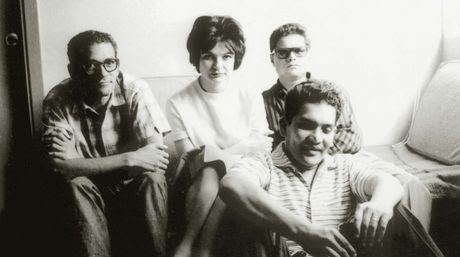
[L-R: Rodolfo Izaguirre, Mary Ferrero, Adriano González León, Caupolicán Ovalles, Caracas, 1962]
I, father of two children
and a wife who supports me
so fucking sick already of so much stupidity
have decided to write to
captain ahab’s widow,
roof of the whale
beneath the wind on the sea.
your kisses please me
tower of the sea to whore in the port,
where we went to live
twenty disgraces for our
hearts.
on the red hill
because of you
police and ministers
discover treasures and secrets
from the past,
beneath the air of the house we inhabit
five hundred promises of love and twenty defeats.
I, father of two women
and a son to support,
wake up,
irritable, pissed off
by a decree of autumn
and the half orange
on the red hill
Originally published in Rayado sobre el techo, no. 1 (Caracas: Ediciones de El Techo de la Ballena, 24 March 1961).
{ Juan Calzadilla, Israel Ortega Oropeza & Daniel González, El Techo de la Ballena: Antología 1961-1969, Caracas: Monte Ávila Editores, 2008 }
12.29.2014
El gran magma / El Techo de la Ballena
The Great Magma
beneath every structure that intends to enclose a process a seed of rupture already exists
we have less capacity for organizing this is evident than for living living is urgent which is why the whale doesn’t need to know about zoology to live
the roof of the whale is founded in the complete uncontrollable lucidity of the orgasm that only insomnia verifies because the whale is the only valid prism it’s the only prism its barbarism has
few realities are as exciting as a name that breaks all the liturgies of language the roof of the whale is more than just a name
under its sway all things will have a point of encounter with the intangible such is the meaning that’s discovered in what the whale has devoured in the skin of the iguana
on the surface of the painting devoured by its own matter the almanacs don’t register everything that can be said about the whale
it’s the cosmic hunger demanding its scream it’s a gesture it’s an attitude just like the singers in style right now the roof of the whale will enjoy an extraordinary popularity
the roof of the whale is a stone animal that resuscitates for the well-being of its guests
the roof of the whale reigns among the frenetic lovers owner of an unconquered matter
Originally published in Rayado sobre el techo, no. 1 (Caracas: Ediciones de El Techo de la Ballena, 24 March 1961).
{ Juan Calzadilla, Israel Ortega Oropeza & Daniel González, El Techo de la Ballena: Antología 1961-1969, Caracas: Monte Ávila Editores, 2008 }
beneath every structure that intends to enclose a process a seed of rupture already exists
we have less capacity for organizing this is evident than for living living is urgent which is why the whale doesn’t need to know about zoology to live
the roof of the whale is founded in the complete uncontrollable lucidity of the orgasm that only insomnia verifies because the whale is the only valid prism it’s the only prism its barbarism has
few realities are as exciting as a name that breaks all the liturgies of language the roof of the whale is more than just a name
under its sway all things will have a point of encounter with the intangible such is the meaning that’s discovered in what the whale has devoured in the skin of the iguana
on the surface of the painting devoured by its own matter the almanacs don’t register everything that can be said about the whale
it’s the cosmic hunger demanding its scream it’s a gesture it’s an attitude just like the singers in style right now the roof of the whale will enjoy an extraordinary popularity
the roof of the whale is a stone animal that resuscitates for the well-being of its guests
the roof of the whale reigns among the frenetic lovers owner of an unconquered matter
Originally published in Rayado sobre el techo, no. 1 (Caracas: Ediciones de El Techo de la Ballena, 24 March 1961).
{ Juan Calzadilla, Israel Ortega Oropeza & Daniel González, El Techo de la Ballena: Antología 1961-1969, Caracas: Monte Ávila Editores, 2008 }
12.28.2014
Para la restitución del magma / El Techo de la Ballena
For the Restitution of the Magma
We have to restore the magma the boiling matter the lust of lava to place a cloth at the foot of a volcano to restore the world the lust of the lava to demonstrate that matter is more lucid than color in this way the amorphous amputated from reality all the superfluous things that impede it from transcending itself overcome the immediacy of matter as a means of expression making it not an executing instrument but yes an acting medium that becomes an outbreak impact matter is transcended the textures tremble the rhythms tend toward vertigo what presides the act of creating which is to force yourself-leave a record that you exist because we have to restore the magma as it falls... informalism relocates it within the full activity of creating reestablishes categories and relationships that science already predicts because informalism also has its mushroom the touch of an arbitrary matter that runs to the most incredulous eyes is a possibility of creation as real and as evident as the earth and stone the mountains configure because we have to restore the magma the boiling matter Adam’s prosthesis.
Originally published in Rayado sobre el techo, no. 1 (Caracas: Ediciones de El Techo de la Ballena, 24 March 1961), shown in the photograph above. Illustration by Ángel Luque.
{ Juan Calzadilla, Israel Ortega Oropeza & Daniel González, El Techo de la Ballena: Antología 1961-1969, Caracas: Monte Ávila Editores, 2008 }
We have to restore the magma the boiling matter the lust of lava to place a cloth at the foot of a volcano to restore the world the lust of the lava to demonstrate that matter is more lucid than color in this way the amorphous amputated from reality all the superfluous things that impede it from transcending itself overcome the immediacy of matter as a means of expression making it not an executing instrument but yes an acting medium that becomes an outbreak impact matter is transcended the textures tremble the rhythms tend toward vertigo what presides the act of creating which is to force yourself-leave a record that you exist because we have to restore the magma as it falls... informalism relocates it within the full activity of creating reestablishes categories and relationships that science already predicts because informalism also has its mushroom the touch of an arbitrary matter that runs to the most incredulous eyes is a possibility of creation as real and as evident as the earth and stone the mountains configure because we have to restore the magma the boiling matter Adam’s prosthesis.
Originally published in Rayado sobre el techo, no. 1 (Caracas: Ediciones de El Techo de la Ballena, 24 March 1961), shown in the photograph above. Illustration by Ángel Luque.
{ Juan Calzadilla, Israel Ortega Oropeza & Daniel González, El Techo de la Ballena: Antología 1961-1969, Caracas: Monte Ávila Editores, 2008 }
12.27.2014
Resurrección de El Techo de la Ballena / Oswaldo Barreto
Resurrection of El Techo de la Ballena
It’s not the result of a belated and vulgar pretension to elaborate surrealist texts, nor a desire to evade realities as pressing as the recent meeting of the presidents of Brazil and Venezuela that anxiously turned out to be so poor in actual political or diplomatic results, the imminent restitution of Manuel Zelaya to the presidency of Honduras, or the ferocity that terrorism has reached throughout all borders. No, none of that, but rather, as we will try to reveal, it’s a mere desire to understand one of the most complex aspects of our exceedingly complex sociocultural reality.
A CURIOUS OFFICIAL INVITATION
This whole matter began, let’s say it without further preambles, when one of my former students thought to send me via email the following official invitation: “The Ministry of Popular Power for Culture, through Monte Ávila Editores Latinoamericana, has the pleasure of inviting you to the presentation of the book El Techo de la Ballena: Antología 1961-1969 coinciding with the exhibit “El Techo de la Ballena: Half A Century Later.” Sunday, 1 November 2009, 11am. National Gallery of Art. With the participation of Carlos Noguera, Juan Calzadilla, Edmundo Aray, Daniel González, Josefina Urdaneta. Dedicated in memory of the deceased members of El Techo de la Ballena: Carlos Contramaestre, Caupolicán Ovalles, Adriano González León, Salvador Garmendia, Alberto Brandt, J.M Cruxent, Efraín Hurtado, Dámaso Ogaz, Hugo Batista, Gonzalo Castellanos, Mary Ferrero, Juan Antonio Vasco, David Alizo.”
After realizing that my young friend, precisely because he’s young couldn’t perceive anything extraordinary in this text, no miracles or surrealist conjuring, and that he couldn’t imagine he was committing an abuse by sending me what for him was an anodyne invitation for any citizen, I had no awareness beyond thinking that I was facing the possibility that the miracle resurrection continues to be would very soon occur. Exactly one day before the date when all us mortals come into contact again with the dead, the aforementioned organisms of the State were, in effect, inviting us to the resurrection of one of the most important cultural (artistic and literary) groups to have existed in Venezuela, El Techo de la Ballena [The Roof of the Whale].
The sponsors of the event, who appear in the invitation as participants, are well-known intellectuals, four of whom work or have worked as functionaries or advisors for administrative organisms of the current regime and are among the most recognized intellectuals of Chavismo. Three of them, relatedly, Calzadilla, Aray and González, share another multiple condition: they are among the founders, the most active members and most prolific creators of El Techo de la Ballena.
The tribute they want to offer with this publication to the members who expressly designate themselves as such, then, is a tribute that the surviving members of El Techo de la Ballena offer to the deceased members in honor of what the entire group represented, and to the work they produced as a collective and as individuals. And this work, in the field of literature, in cultural action at conferences, gatherings and congresses, in exhibits of plastic arts and in cinema, extends throughout eight years, from 1961 to 1969. It is a unique oeuvre in the history of Venezuela’s cultural life because of its qualities and dimensions, but it’s an oeuvre that only remains in the memory of those of us who shared with them the political and cultural life in Venezuela during the sixties and, of course, in the libraries and archives where it continues to await researchers, specialists and scholars. To place those texts within reach of readers today, to reproduce the catalogs for the exhibits they held or to once again show what they did in cinema, there is no other way to describe this than as a resurrection of the group, a resurrection of The Whale.
Resurrections in the field of culture don’t represent anything new or strange. In our era, in particular, an era of information and of an ample distribution of art through media, not only mechanical but also electronic, it’s not extraordinary, nor would it usually catch the attention of someone like me who’s concerned with fundamentally political matters. But this resurrection has something absolutely particular to it: it’s not a matter, as it tends to happen, of a living person who resuscitates a dead one, usually someone who’s from another era and another spirit. Here we find that the resuscitators are part of the being they are resuscitating or, if you prefer, that the resuscitated ones formed part of the same being that now returns them to the world.
And this is the political problem and the sociocultural problem that is absolutely our own, of this era that has begun with the advent of Chavismo. Three of the resuscitators, as we have already indicated, assume their condition of being Chavistas and have responsibilities within the cultural actions of the regime. Now, the cultural politics of the current regime, the Chavista conception of culture is situated in many levels at the antipodes of the cultural actions and the spirit that moved the immense and excellent productions of El Techo de la Ballena. This production is oriented towards the struggle against “old literature, old art, rhetoric, demagogic realism, intellectualism, professors, sectarians, President Rómulo Betancourt’s police and the infantry of the U.S. Marines,” as the novelist Adriano González León wrote. And, what is even more defining of the group, freedom of creation was for them a sine qua non condition for the existence of art and literature. And, by demanding freedom of creation, they always declared themselves as supporters of tolerance and dialogue and rejected all forms of authoritarianism in the field of cultural actions by those in power.
Have the remaining members truly resurrected El Techo de la Ballena today?
{ Oswaldo Barreto, Tal Cual, 3 November 2009 }
It’s not the result of a belated and vulgar pretension to elaborate surrealist texts, nor a desire to evade realities as pressing as the recent meeting of the presidents of Brazil and Venezuela that anxiously turned out to be so poor in actual political or diplomatic results, the imminent restitution of Manuel Zelaya to the presidency of Honduras, or the ferocity that terrorism has reached throughout all borders. No, none of that, but rather, as we will try to reveal, it’s a mere desire to understand one of the most complex aspects of our exceedingly complex sociocultural reality.
A CURIOUS OFFICIAL INVITATION
This whole matter began, let’s say it without further preambles, when one of my former students thought to send me via email the following official invitation: “The Ministry of Popular Power for Culture, through Monte Ávila Editores Latinoamericana, has the pleasure of inviting you to the presentation of the book El Techo de la Ballena: Antología 1961-1969 coinciding with the exhibit “El Techo de la Ballena: Half A Century Later.” Sunday, 1 November 2009, 11am. National Gallery of Art. With the participation of Carlos Noguera, Juan Calzadilla, Edmundo Aray, Daniel González, Josefina Urdaneta. Dedicated in memory of the deceased members of El Techo de la Ballena: Carlos Contramaestre, Caupolicán Ovalles, Adriano González León, Salvador Garmendia, Alberto Brandt, J.M Cruxent, Efraín Hurtado, Dámaso Ogaz, Hugo Batista, Gonzalo Castellanos, Mary Ferrero, Juan Antonio Vasco, David Alizo.”
After realizing that my young friend, precisely because he’s young couldn’t perceive anything extraordinary in this text, no miracles or surrealist conjuring, and that he couldn’t imagine he was committing an abuse by sending me what for him was an anodyne invitation for any citizen, I had no awareness beyond thinking that I was facing the possibility that the miracle resurrection continues to be would very soon occur. Exactly one day before the date when all us mortals come into contact again with the dead, the aforementioned organisms of the State were, in effect, inviting us to the resurrection of one of the most important cultural (artistic and literary) groups to have existed in Venezuela, El Techo de la Ballena [The Roof of the Whale].
The sponsors of the event, who appear in the invitation as participants, are well-known intellectuals, four of whom work or have worked as functionaries or advisors for administrative organisms of the current regime and are among the most recognized intellectuals of Chavismo. Three of them, relatedly, Calzadilla, Aray and González, share another multiple condition: they are among the founders, the most active members and most prolific creators of El Techo de la Ballena.
The tribute they want to offer with this publication to the members who expressly designate themselves as such, then, is a tribute that the surviving members of El Techo de la Ballena offer to the deceased members in honor of what the entire group represented, and to the work they produced as a collective and as individuals. And this work, in the field of literature, in cultural action at conferences, gatherings and congresses, in exhibits of plastic arts and in cinema, extends throughout eight years, from 1961 to 1969. It is a unique oeuvre in the history of Venezuela’s cultural life because of its qualities and dimensions, but it’s an oeuvre that only remains in the memory of those of us who shared with them the political and cultural life in Venezuela during the sixties and, of course, in the libraries and archives where it continues to await researchers, specialists and scholars. To place those texts within reach of readers today, to reproduce the catalogs for the exhibits they held or to once again show what they did in cinema, there is no other way to describe this than as a resurrection of the group, a resurrection of The Whale.
Resurrections in the field of culture don’t represent anything new or strange. In our era, in particular, an era of information and of an ample distribution of art through media, not only mechanical but also electronic, it’s not extraordinary, nor would it usually catch the attention of someone like me who’s concerned with fundamentally political matters. But this resurrection has something absolutely particular to it: it’s not a matter, as it tends to happen, of a living person who resuscitates a dead one, usually someone who’s from another era and another spirit. Here we find that the resuscitators are part of the being they are resuscitating or, if you prefer, that the resuscitated ones formed part of the same being that now returns them to the world.
And this is the political problem and the sociocultural problem that is absolutely our own, of this era that has begun with the advent of Chavismo. Three of the resuscitators, as we have already indicated, assume their condition of being Chavistas and have responsibilities within the cultural actions of the regime. Now, the cultural politics of the current regime, the Chavista conception of culture is situated in many levels at the antipodes of the cultural actions and the spirit that moved the immense and excellent productions of El Techo de la Ballena. This production is oriented towards the struggle against “old literature, old art, rhetoric, demagogic realism, intellectualism, professors, sectarians, President Rómulo Betancourt’s police and the infantry of the U.S. Marines,” as the novelist Adriano González León wrote. And, what is even more defining of the group, freedom of creation was for them a sine qua non condition for the existence of art and literature. And, by demanding freedom of creation, they always declared themselves as supporters of tolerance and dialogue and rejected all forms of authoritarianism in the field of cultural actions by those in power.
Have the remaining members truly resurrected El Techo de la Ballena today?
{ Oswaldo Barreto, Tal Cual, 3 November 2009 }
3.11.2009
El Nadaísmo y El Techo de la Ballena / Juan Calzadilla
Nadaísmo and El Techo de la Ballena
[Photo: Verbigracia, 2002. El Techo de la Ballena in 1963, L-R: Juan Calzadilla, Salvador Garmendia, Zonia Asparren M., José María Cruxent and Adriano González León.]
In what ways do El Techo de la Ballena and Nadaísmo identify or distance themselves from each other, in terms of their proposals, influences and their actions in common? On principle, I wouldn’t ask myself this question if I wasn’t sure that the similarities that joined us together are greater than the differences that might emerge from studying the two very different contexts in which both groups moved. A social context on the Colombian side and a political context on the Venezuelan side.
This peak I refer to should be understood keeping in mind that the Nadaísta movement remains active, even if hidden, and has now moved into a retroactive phase that surprises us with the boom of its editorial activities, not just in the present production of its living representatives, but also the launching of new work, always under the banner of Nadaísmo, while far from resigning itself to succumbing, it continues to generate polemical information, year after year, as a corollary to a long collective history of processes, that its most radical apologists, Jotamario, Eduardo Escobar and Armando Romero, are committed to defending until the end. This is how Nadaísmo has become not only the literary group with the longest history in Latin America, but also the most prolific in actions and in work collected in books.
A History in Fragments
The history of El Techo de la Ballena is shorter and more elliptical and can be contained in a work that gathers seven or eight months of battle, viscous humor, acts within jurisdictions and non-conformist challenges, as can be seen in an austere and stingy work of criticism that, in the absence of a more exhaustive and complete publication, continues to be the anthology by Angel Rama (Fundarte, 1987), the most consulted text and practically the only example of value-driven matter to be written about the group. And yet as an anthology, it is an enormously minor publication. The editorial luck of El Techo de la Ballena is not a limitation that can be attributed to the group not being very productive. On the contrary , we all know there’s plenty of material in magazines and newspapers, or still unpublished or that hasn’t been gathered into a book, particularly those of graphic or testimonial nature. And I provide as an example the profuse, intransigent, and very singular work of Dámaso Ogaz, today scattered and at risk of being lost in experimental magazines edited by mimeograph in an artisan manner by Ogaz himself, during his long via cruces in the Venezuelan provinces. Or the extensive autobiographical poetry of Caupolicán Ovalles, delicately published in the form of bricks that, in order to oppose other more traditional publications, Edmundo Aray called tubular editions, throwing them into political events and exhibits.
The good critical fortune of Nadaísmo is explained in part by this movement’s continuity, since its foundation in 1959 until today, throughout what has perhaps been the most dynamic and controversial chapter of modern Colombian literature. In this sense, the fact that its central chroniclers are its most polemical members, has helped Nadaísmo attain greater unity and guarantee, despite the ravages of time, desertions and death, coherence with its first propositions, which is to say, an attack against bourgeois morality, the use of daring humor, subversion against the clerical institution and preaching anarchy as a subversive form.
The same does not happen with El Techo de la Ballena, whose trajectory was more brief, so it makes sense their dedication was more circumstantial, or if you’d like, more factual with events, although no less corrosive and transverse than the position Nadaísmo took in relation to Colombian reality. And if the former’s brevity does not serve in detriment of its importance, it is no less true what Angel Rama said when describing El Techo, in the prologue to the cited anthology, that “it was the product of a historical circumstance that moves while this circumstance transmutes, loses its characteristics and gives in to the most traditional forms of creation: the book, individual tasks, art.” According to Rama, “it was the confirmation of the failure of a defeat after which began the current every man for himself phase.” Although we can highlight the debatable content of this last affirmation, the truth is that El Techo was stopped by the loss of impulse to continue existing beyond the disappearance of the adverse conditions that were stimulating it.
It is evident that in the absence of leadership like that exercised by Gonzalo Arango in Nadaísmo, the cohesion of El Techo de la Ballena depended much more on the coherence of its transitory proposals and the challenges posed by them, than on weak generational connections, whose absence for the same reason contributed to members of the group having a more heterogeneous and open conception of the literary act and a less interdisciplinary one than what defined Nadaísmo, a matter that can be noted by comparing the Ballenero conception of the poem with the colloquial, narrative, unabashedly realist or descriptive tones that serve as common factors in the poetics of Gonzalo Arango, Jaime Jaramillo Escobar, Jotamario Arbeláez, Eduardo Escobar, Eduardo Zalamea and Elmo Valencia, and without taking away anything from the personal tone each one of these poets fiercely maintained. The diversity of styles and thematic registers in the poets of El Techo, aside from corresponding to formal or generational differences, indisputably carries with it an ingredient of anarchy or indolence that contributed to the group’s dispersion.
This common element of rejecting traditional lyricism on the part of the Nadaístas and the Balleneros remits, in both movements, to a recourse to Surrealism, or if you will the tradition of French poetry, just as Jotamario himself recognizes when he writes that “we practically dug up Lautréamont, the surrealists, Rimbaud, in our effort to change life” (this “to change life” is taken from Rimbaud and Jotamario thus underlines it). Although the surrealist precedent in El Techo de la Ballena can also be seen at a certain point as being defined by subscription or militancy, such as with the anti-clerical manifesto “Para aplastar el infinito,” and as could be observed in the use of automatic writing to compose their principal texts, as for example with Los venenos fieles or Dictado por la jauría, one has to say however that fantastic invention or the appeal to the absurd, to the unusual metaphor and to black humor as resources of speech placed in the service of writing in its goal to hyper-sensitize events, all this not the result, as one might think, of a mere adoption or copying of surrealist language, but rather it was a consequence of the development of imagining forms (or metadialectics, as linguists would say) inherent to radical expressive behavior, in tune with our realities, and surging as a reaction to the medium in which both groups had to move for impact and, as Aray used to say, with no gloves on. If we can speak of a model borrowed, as was the case with Surrealism, nothing stops us from accepting that what passed into our language from this model was a transformation of poetic speech.
We would have to add to the search for a foundation in other linguistic traditions, that Jotamario opposes to Spanish lyricism and the local traditions of it, the numerous affinities that filter quickly through the visceral body of Beat poetry and especially that of Ginsberg, Kerouac, Corso and Ferlinghetti, influences or maybe affinities who might have more consistency among the Nadaístas than in the language of the Balleneros, with the exception of Caupolicán Ovalles who, it turns out, face to face with what we’re recounting and if we compare his poetics with the rest of his companions from El Techo, was the one closest to the unabashedly colloquial spirit of the Nadaístas, as can be seen by his poem “¿Duerme usted señor presidente?” (1961).
Amid those attuned components, inspired by poetics from other languages and articulated toward our own, we find the recuperation of orality that proceeds from a few poets of the Colombian tradition, such as León de Greiff and Barba Jacob, in the same way they incorporate to the poetic language the profanities of common use in ghetto slang, as primarily glimpsed in the work of Mario Rivero, who somehow became for the Nadaístas, or for a few Nadaístas, the equivalent of what the work of Ramos Sucre or Juan Antonio Vasco indisputably meant for the Balleneros.
Literary Genres
Another type of investigation around the relationships between both groups could lead us to a consideration of the genres in which they wrote, which implies saying that the innovative aspect of their proposals, in terms of the forms themselves, is sustained in a radical opposition to social realism that continued to be written or painted in both countries around the time those groups emerged. And naturally this opposition, which saw clearly the importance of watching out for form in writing, didn’t result in El Techo de la Ballena or in Nadaísmo to be a perfectionist preoccupation and without even asking about the problem of style, but instead actually mocked everything that could seem too literary, cold, rhetorical or formally sacrificed to freedom for the sake of doing anything they wanted to with literary genres.
Regardless of whether Nadaísmo was a predominantly lyrical movement, or in whose origin we find poetry, we musn’t forget the narrative attempts their representatives more or less take on, as in the case of Jotamario, who fortunately for those of us who follow his poetry, confesses that he’s a frustrated novelist, the author of an epic poetry organized in blocks sewn with tailor’s thread. Gonzalo Arango, without abandoning poetry, presents himself as a precursor to crime fiction in Colombia, while Armando Romero and Elmo Valencia continue to ambidextreously produce poetry and stories. Jaime Jaramillo Escobar, the most metaphysical and marble-like of the nadaístas, is like a herald of the Colombian apocalypse erected in a statue barnished by the Roman moon of one of De Chirico’s plazas. Jaime has been in charge of petrifying the gestures of a real parody that’s not very well-constructed until he’s able to displace history for a puppet theater. Armando Romero, the youngest of the group, crossed Nadaísmo’s borders to wander like a hippie, backpack on his shoulder, through many countries, before settling in our Mérida, where he became the protagonist of the most corrosive farce that any writer has told in order to unmask, in a hilarious novel like La piel por la piel, the terrors and miseries of the Venezuelan university.
Common Origins
Nadaísmo and El Techo de la Ballena were groups that challenged, surging almost simultaneously in Colombia and Venezuela amid and as an expression of violent ruptures and historical cuts that shook the sociopolitical structures and the cultures of both nations.
Starting in the sixties – as Jotamario Arbeláez wrote – all of America was a great poetic commotion. Cuba was a focal point of suns over the hope of the new man. All the poetries founded movements and magazines that carried the airs of renovating language and the overwhelming sensibility of the moment that was this century. That’s how it went in Colombia and in Venezuela, this country we love as if part of it were ours, that miracle of challenging expressions, with all the violence of a perfidious humor and a butchering confrontation, that in Venezuela was called El Techo de la Ballena and in Colombia Nadaísmo.
It’s true that El Techo could claim for itself a larger portion of compromise facing the political violence that operated from power, an even a larger dose of utopian delirium and of stubborn experimentalism to the utmost, but in poetry we never reached in Venezuela, neither then nor later, to a derangement of the senses of such virulence as the one provided by the Nadaísta tribe of an unrestricted and unrestrained cult to insensitivity and situations at the limits.
Plastic Arts or the Informalist Insubordination
Another important analogy is the passion for plastic arts and the energy with which both movements moved to integrate them to the program of intellectual subversion. If this characteristic is more blatant in El Techo de la Ballena, for whom painting played a decisive role in the innovative proposals. But it would be better to explain. We founded our group at a moment when the avant garde in the plastic arts were reaching in Venezuela a tense and unbearably hypocritical atmosphere. The fact that several of the group’s activists were painters and art critics precipitated even more, by means of manifestos and exhibits, the alliance between literature and art in order to accomplish a result that would have never reached such a burning and radical moment if each discipline had marched separately, or if they hadn’t complemented each other in the way they did; the integration of both manifestations, literature and art, can be appreciated from the start at the group’s launch in March of 1961, through the exhibit “Para restituir el magma,” whose purpose, more than showing the work, even if they were of an experimental nature, was to provoke a scandal.
El Techo de la Ballena and Nadaísmo were polemical movements and it was precisely polemic that mostly nurtured the disaffection with the system that moved them to achieve higher objectives which when translated to literature and art produced innovative and subversive work. That its main enemies could have been found among the people who proclaimed themselves with the title of true revolutionaries, is nothing more than a formality which both groups knew how to take advantage of so as to point out with foresight that with Nadaísmo and El Techo de la Ballena an end was being imposed on the history of literary groups, but also on the reign of utopias.
{ Juan Calzadilla, Verbigracia, El Universal, 16 November 2002 }
[Photo: Verbigracia, 2002. El Techo de la Ballena in 1963, L-R: Juan Calzadilla, Salvador Garmendia, Zonia Asparren M., José María Cruxent and Adriano González León.]In what ways do El Techo de la Ballena and Nadaísmo identify or distance themselves from each other, in terms of their proposals, influences and their actions in common? On principle, I wouldn’t ask myself this question if I wasn’t sure that the similarities that joined us together are greater than the differences that might emerge from studying the two very different contexts in which both groups moved. A social context on the Colombian side and a political context on the Venezuelan side.
This peak I refer to should be understood keeping in mind that the Nadaísta movement remains active, even if hidden, and has now moved into a retroactive phase that surprises us with the boom of its editorial activities, not just in the present production of its living representatives, but also the launching of new work, always under the banner of Nadaísmo, while far from resigning itself to succumbing, it continues to generate polemical information, year after year, as a corollary to a long collective history of processes, that its most radical apologists, Jotamario, Eduardo Escobar and Armando Romero, are committed to defending until the end. This is how Nadaísmo has become not only the literary group with the longest history in Latin America, but also the most prolific in actions and in work collected in books.
A History in Fragments
The history of El Techo de la Ballena is shorter and more elliptical and can be contained in a work that gathers seven or eight months of battle, viscous humor, acts within jurisdictions and non-conformist challenges, as can be seen in an austere and stingy work of criticism that, in the absence of a more exhaustive and complete publication, continues to be the anthology by Angel Rama (Fundarte, 1987), the most consulted text and practically the only example of value-driven matter to be written about the group. And yet as an anthology, it is an enormously minor publication. The editorial luck of El Techo de la Ballena is not a limitation that can be attributed to the group not being very productive. On the contrary , we all know there’s plenty of material in magazines and newspapers, or still unpublished or that hasn’t been gathered into a book, particularly those of graphic or testimonial nature. And I provide as an example the profuse, intransigent, and very singular work of Dámaso Ogaz, today scattered and at risk of being lost in experimental magazines edited by mimeograph in an artisan manner by Ogaz himself, during his long via cruces in the Venezuelan provinces. Or the extensive autobiographical poetry of Caupolicán Ovalles, delicately published in the form of bricks that, in order to oppose other more traditional publications, Edmundo Aray called tubular editions, throwing them into political events and exhibits.
The good critical fortune of Nadaísmo is explained in part by this movement’s continuity, since its foundation in 1959 until today, throughout what has perhaps been the most dynamic and controversial chapter of modern Colombian literature. In this sense, the fact that its central chroniclers are its most polemical members, has helped Nadaísmo attain greater unity and guarantee, despite the ravages of time, desertions and death, coherence with its first propositions, which is to say, an attack against bourgeois morality, the use of daring humor, subversion against the clerical institution and preaching anarchy as a subversive form.
The same does not happen with El Techo de la Ballena, whose trajectory was more brief, so it makes sense their dedication was more circumstantial, or if you’d like, more factual with events, although no less corrosive and transverse than the position Nadaísmo took in relation to Colombian reality. And if the former’s brevity does not serve in detriment of its importance, it is no less true what Angel Rama said when describing El Techo, in the prologue to the cited anthology, that “it was the product of a historical circumstance that moves while this circumstance transmutes, loses its characteristics and gives in to the most traditional forms of creation: the book, individual tasks, art.” According to Rama, “it was the confirmation of the failure of a defeat after which began the current every man for himself phase.” Although we can highlight the debatable content of this last affirmation, the truth is that El Techo was stopped by the loss of impulse to continue existing beyond the disappearance of the adverse conditions that were stimulating it.
It is evident that in the absence of leadership like that exercised by Gonzalo Arango in Nadaísmo, the cohesion of El Techo de la Ballena depended much more on the coherence of its transitory proposals and the challenges posed by them, than on weak generational connections, whose absence for the same reason contributed to members of the group having a more heterogeneous and open conception of the literary act and a less interdisciplinary one than what defined Nadaísmo, a matter that can be noted by comparing the Ballenero conception of the poem with the colloquial, narrative, unabashedly realist or descriptive tones that serve as common factors in the poetics of Gonzalo Arango, Jaime Jaramillo Escobar, Jotamario Arbeláez, Eduardo Escobar, Eduardo Zalamea and Elmo Valencia, and without taking away anything from the personal tone each one of these poets fiercely maintained. The diversity of styles and thematic registers in the poets of El Techo, aside from corresponding to formal or generational differences, indisputably carries with it an ingredient of anarchy or indolence that contributed to the group’s dispersion.
This common element of rejecting traditional lyricism on the part of the Nadaístas and the Balleneros remits, in both movements, to a recourse to Surrealism, or if you will the tradition of French poetry, just as Jotamario himself recognizes when he writes that “we practically dug up Lautréamont, the surrealists, Rimbaud, in our effort to change life” (this “to change life” is taken from Rimbaud and Jotamario thus underlines it). Although the surrealist precedent in El Techo de la Ballena can also be seen at a certain point as being defined by subscription or militancy, such as with the anti-clerical manifesto “Para aplastar el infinito,” and as could be observed in the use of automatic writing to compose their principal texts, as for example with Los venenos fieles or Dictado por la jauría, one has to say however that fantastic invention or the appeal to the absurd, to the unusual metaphor and to black humor as resources of speech placed in the service of writing in its goal to hyper-sensitize events, all this not the result, as one might think, of a mere adoption or copying of surrealist language, but rather it was a consequence of the development of imagining forms (or metadialectics, as linguists would say) inherent to radical expressive behavior, in tune with our realities, and surging as a reaction to the medium in which both groups had to move for impact and, as Aray used to say, with no gloves on. If we can speak of a model borrowed, as was the case with Surrealism, nothing stops us from accepting that what passed into our language from this model was a transformation of poetic speech.
We would have to add to the search for a foundation in other linguistic traditions, that Jotamario opposes to Spanish lyricism and the local traditions of it, the numerous affinities that filter quickly through the visceral body of Beat poetry and especially that of Ginsberg, Kerouac, Corso and Ferlinghetti, influences or maybe affinities who might have more consistency among the Nadaístas than in the language of the Balleneros, with the exception of Caupolicán Ovalles who, it turns out, face to face with what we’re recounting and if we compare his poetics with the rest of his companions from El Techo, was the one closest to the unabashedly colloquial spirit of the Nadaístas, as can be seen by his poem “¿Duerme usted señor presidente?” (1961).
Amid those attuned components, inspired by poetics from other languages and articulated toward our own, we find the recuperation of orality that proceeds from a few poets of the Colombian tradition, such as León de Greiff and Barba Jacob, in the same way they incorporate to the poetic language the profanities of common use in ghetto slang, as primarily glimpsed in the work of Mario Rivero, who somehow became for the Nadaístas, or for a few Nadaístas, the equivalent of what the work of Ramos Sucre or Juan Antonio Vasco indisputably meant for the Balleneros.
Literary Genres
Another type of investigation around the relationships between both groups could lead us to a consideration of the genres in which they wrote, which implies saying that the innovative aspect of their proposals, in terms of the forms themselves, is sustained in a radical opposition to social realism that continued to be written or painted in both countries around the time those groups emerged. And naturally this opposition, which saw clearly the importance of watching out for form in writing, didn’t result in El Techo de la Ballena or in Nadaísmo to be a perfectionist preoccupation and without even asking about the problem of style, but instead actually mocked everything that could seem too literary, cold, rhetorical or formally sacrificed to freedom for the sake of doing anything they wanted to with literary genres.
Regardless of whether Nadaísmo was a predominantly lyrical movement, or in whose origin we find poetry, we musn’t forget the narrative attempts their representatives more or less take on, as in the case of Jotamario, who fortunately for those of us who follow his poetry, confesses that he’s a frustrated novelist, the author of an epic poetry organized in blocks sewn with tailor’s thread. Gonzalo Arango, without abandoning poetry, presents himself as a precursor to crime fiction in Colombia, while Armando Romero and Elmo Valencia continue to ambidextreously produce poetry and stories. Jaime Jaramillo Escobar, the most metaphysical and marble-like of the nadaístas, is like a herald of the Colombian apocalypse erected in a statue barnished by the Roman moon of one of De Chirico’s plazas. Jaime has been in charge of petrifying the gestures of a real parody that’s not very well-constructed until he’s able to displace history for a puppet theater. Armando Romero, the youngest of the group, crossed Nadaísmo’s borders to wander like a hippie, backpack on his shoulder, through many countries, before settling in our Mérida, where he became the protagonist of the most corrosive farce that any writer has told in order to unmask, in a hilarious novel like La piel por la piel, the terrors and miseries of the Venezuelan university.
Common Origins
Nadaísmo and El Techo de la Ballena were groups that challenged, surging almost simultaneously in Colombia and Venezuela amid and as an expression of violent ruptures and historical cuts that shook the sociopolitical structures and the cultures of both nations.
Starting in the sixties – as Jotamario Arbeláez wrote – all of America was a great poetic commotion. Cuba was a focal point of suns over the hope of the new man. All the poetries founded movements and magazines that carried the airs of renovating language and the overwhelming sensibility of the moment that was this century. That’s how it went in Colombia and in Venezuela, this country we love as if part of it were ours, that miracle of challenging expressions, with all the violence of a perfidious humor and a butchering confrontation, that in Venezuela was called El Techo de la Ballena and in Colombia Nadaísmo.
It’s true that El Techo could claim for itself a larger portion of compromise facing the political violence that operated from power, an even a larger dose of utopian delirium and of stubborn experimentalism to the utmost, but in poetry we never reached in Venezuela, neither then nor later, to a derangement of the senses of such virulence as the one provided by the Nadaísta tribe of an unrestricted and unrestrained cult to insensitivity and situations at the limits.
Plastic Arts or the Informalist Insubordination
Another important analogy is the passion for plastic arts and the energy with which both movements moved to integrate them to the program of intellectual subversion. If this characteristic is more blatant in El Techo de la Ballena, for whom painting played a decisive role in the innovative proposals. But it would be better to explain. We founded our group at a moment when the avant garde in the plastic arts were reaching in Venezuela a tense and unbearably hypocritical atmosphere. The fact that several of the group’s activists were painters and art critics precipitated even more, by means of manifestos and exhibits, the alliance between literature and art in order to accomplish a result that would have never reached such a burning and radical moment if each discipline had marched separately, or if they hadn’t complemented each other in the way they did; the integration of both manifestations, literature and art, can be appreciated from the start at the group’s launch in March of 1961, through the exhibit “Para restituir el magma,” whose purpose, more than showing the work, even if they were of an experimental nature, was to provoke a scandal.
El Techo de la Ballena and Nadaísmo were polemical movements and it was precisely polemic that mostly nurtured the disaffection with the system that moved them to achieve higher objectives which when translated to literature and art produced innovative and subversive work. That its main enemies could have been found among the people who proclaimed themselves with the title of true revolutionaries, is nothing more than a formality which both groups knew how to take advantage of so as to point out with foresight that with Nadaísmo and El Techo de la Ballena an end was being imposed on the history of literary groups, but also on the reign of utopias.
{ Juan Calzadilla, Verbigracia, El Universal, 16 November 2002 }
6.05.2005
El Techo de la Ballena
I spent the late afternoon yesterday sitting in a park in Cambridge by the Charles, reading more of Juan Villoro's novel El testigo. I'm midway through the book and am enjoying it very much.
While the protagonist, Julio Valdivieso, sits in a bar in Mexico City one afternoon, he's approached by a homeless man who starts talking to him. It turns out to be an old friend he hasn't seen since they were in a writing workshop together in the early 1970s. His friend is a poet who has fallen on bad times. At one point in their conversation the homeless poet mentions El Techo de la Ballena (The Whale's Roof), a collective of radical young writers and artists during the early 1960s in Caracas which included Juan Calzadilla, Adriano González León, Francisco Pérez Perdomo and Salvador Garmendia, among others:
"Yo tampoco sucedí—sonrió—. Las mafias no me dejaron. Ya sabes cómo es esta pocilga. Si no le lames los huevos al príncipe, te jodes. Aquí sólo hay cortesanos. No hay lugar para los poetas de hierro. Nunca habrá genios indecentes, irregulares, hijos de la chingada. Las vanguardias chidas de América (El Techo de la Ballena, los Nadaístas, La Mandrágora) jamás hubieran ocurrido en México. La rebeldía no es de este rancho. Publiqué en revistas de Perú, de Chile, de Colombia, de Venezuela, ahí tengo brothers, ahí estan mis pares, mis carnales del alma, ¡chupe y chupe! Ahí no importa si un poeta se coge a su perro, no tienes que ser un señorito, un gentleman fifirifi, un cosmopolitólogo, todo lo que hay que aparentar en Mexicalpan de las Tunas. Rolé por los Andes y el Amazonas, encontré poetas de lumbre, no mamadas, nada de haikus sobre la caída de la hoja. Luego me regresé y me hicieron el feo."
I first heard about this group when I was at Naropa in 1993. When I told Allen Ginsberg I was Venezuelan (during a brief conversation) he told me about them, asking if I knew their work. He had received an invitation from them to visit Caracas but he was never able to go.
I've been looking up information on this literary group ever since but much of it is impossible to find in libraries or bookstores here in the US. When I was in Caracas in 2001, I came across an excellent essay on the painters in that collective:
Gabriela Rangel, El Techo de la Ballena. Cambiar la vida, transformar la sociedad. De la pintura moderna a la instalación (Caracas: Espacios Union, Cuadernillo No. 24, 1999).
In November of 2002, El Universal's now defunct literary supplement, Verbigracia, published the following essay on El Techo de la Ballena by Juan Calzadilla: "El Nadaísmo y El Techo de la Ballena." In that same issue, Verbigracia also published a small selection of poems from the group: "Poesía contestataria."
While the protagonist, Julio Valdivieso, sits in a bar in Mexico City one afternoon, he's approached by a homeless man who starts talking to him. It turns out to be an old friend he hasn't seen since they were in a writing workshop together in the early 1970s. His friend is a poet who has fallen on bad times. At one point in their conversation the homeless poet mentions El Techo de la Ballena (The Whale's Roof), a collective of radical young writers and artists during the early 1960s in Caracas which included Juan Calzadilla, Adriano González León, Francisco Pérez Perdomo and Salvador Garmendia, among others:
"Yo tampoco sucedí—sonrió—. Las mafias no me dejaron. Ya sabes cómo es esta pocilga. Si no le lames los huevos al príncipe, te jodes. Aquí sólo hay cortesanos. No hay lugar para los poetas de hierro. Nunca habrá genios indecentes, irregulares, hijos de la chingada. Las vanguardias chidas de América (El Techo de la Ballena, los Nadaístas, La Mandrágora) jamás hubieran ocurrido en México. La rebeldía no es de este rancho. Publiqué en revistas de Perú, de Chile, de Colombia, de Venezuela, ahí tengo brothers, ahí estan mis pares, mis carnales del alma, ¡chupe y chupe! Ahí no importa si un poeta se coge a su perro, no tienes que ser un señorito, un gentleman fifirifi, un cosmopolitólogo, todo lo que hay que aparentar en Mexicalpan de las Tunas. Rolé por los Andes y el Amazonas, encontré poetas de lumbre, no mamadas, nada de haikus sobre la caída de la hoja. Luego me regresé y me hicieron el feo."
I first heard about this group when I was at Naropa in 1993. When I told Allen Ginsberg I was Venezuelan (during a brief conversation) he told me about them, asking if I knew their work. He had received an invitation from them to visit Caracas but he was never able to go.
I've been looking up information on this literary group ever since but much of it is impossible to find in libraries or bookstores here in the US. When I was in Caracas in 2001, I came across an excellent essay on the painters in that collective:
Gabriela Rangel, El Techo de la Ballena. Cambiar la vida, transformar la sociedad. De la pintura moderna a la instalación (Caracas: Espacios Union, Cuadernillo No. 24, 1999).
In November of 2002, El Universal's now defunct literary supplement, Verbigracia, published the following essay on El Techo de la Ballena by Juan Calzadilla: "El Nadaísmo y El Techo de la Ballena." In that same issue, Verbigracia also published a small selection of poems from the group: "Poesía contestataria."
Subscribe to:
Comments (Atom)